

A LiFePO4 battery can accept charge quickly and deliver thousands of useful cycles, but only when the charging source is configured for lithium chemistry. Knowing how to charge a LiFePO4 battery is therefore less about treating it gently than giving it the right voltage limits, charge current and temperature conditions. This matters whether the battery is installed in a motorhome, sailing boat, camper conversion or permanent off-grid power system.
A 12V LiFePO4 battery is normally built from four cells and has a nominal voltage of 12.8V. A 24V battery typically uses eight cells and has a nominal voltage of 25.6V. These figures are not the voltages your charger should supply. Charge voltage, charging current and the battery management system (BMS) limits must all work together.
Use the correct LiFePO4 charging profile
The first requirement is a charger, solar controller or DC-DC charger with a dedicated LiFePO4 or user-programmable profile. A standard lead-acid programme may charge the battery, but it can also use unsuitable float, equalisation or temperature-compensation stages.
For many 12V LiFePO4 batteries, a bulk and absorption voltage between 14.2V and 14.6V is appropriate. The equivalent range for a 24V battery is 28.4V to 29.2V. The precise setting depends on the battery manufacturer, BMS configuration and cell specification, so the battery data sheet always takes priority over a general voltage range.
Unlike lead-acid batteries, LiFePO4 batteries do not need a prolonged absorption stage to complete every charge. Once the battery approaches full charge and the current falls, a lithium charger should end or substantially reduce charging. If a float stage cannot be disabled, a low float setting is commonly used, often around 13.4V to 13.6V for a 12V battery. Continuous high-voltage float charging is unnecessary and can reduce long-term service life.
Disable equalisation, desulphation, reconditioning and pulse-recovery modes. These functions are designed for lead-acid chemistry. They can raise voltage beyond the permitted limit of a LiFePO4 battery and may cause the BMS to disconnect charge as protection.
Temperature compensation should also be switched off unless the battery manufacturer explicitly specifies otherwise. Lead-acid batteries benefit from compensation because their ideal charging voltage changes markedly with temperature. LiFePO4 charging is managed differently, particularly at low temperatures.
Select a charger with suitable current capacity
Charge current is expressed in amps or as a C-rate. For example, charging a 100Ah battery at 20A is a 0.2C charge rate. Many LiFePO4 batteries are comfortable at 0.2C to 0.5C, while some can accept more. The maximum permitted current is set by the battery cells, internal BMS, cable size and the charging equipment, not simply by the battery capacity.
A 20A mains charger is a practical choice for a 100Ah leisure battery when overnight charging is acceptable. A 40A charger will restore energy faster, but only if the battery specification and installation support it. For a larger 200Ah battery bank, a 40A to 60A charging source may provide a sensible balance between recharge time, alternator demand and available shore power.
Do not select a high-output charger simply because the BMS has a high maximum charge-current rating. That rating is a protection limit, not always the preferred everyday operating point. Correctly sized cables, fuses, terminals and ventilation around charging equipment remain essential at every current level.
How to charge a LiFePO4 battery from each power source
Mains or shore power charging
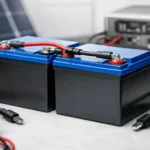
For charging at home, on a campsite hook-up or from marina shore power, use a mains-powered lithium battery charger matched to the bank voltage. Connect the positive charger lead through a correctly rated fuse close to the battery positive terminal, then connect the negative lead to the battery negative terminal or the designated system negative point.
Before switching on, confirm that the charger is set to LiFePO4 mode and that its output current does not exceed the battery’s stated charge limit. A quality charger will provide bulk charging until the programmed voltage is reached, then reduce current as the battery fills. The BMS is a final layer of protection, but it should not be used as the normal method of ending an over-voltage charge.
Solar charging
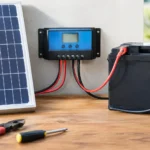
Solar is particularly effective for motorhomes, boats and independent installations because LiFePO4 batteries accept available current efficiently through much of their state of charge. The solar panels must feed the battery through a PWM or, preferably in many systems, MPPT solar charge controller configured for lithium.
Set the controller’s absorption voltage, float voltage and absorption time according to the battery guidance. Disable equalisation. An MPPT controller is often the stronger option where panel voltage is higher than battery voltage, cable runs are longer, or roof space is limited and every watt matters. It converts excess panel voltage into useful charging current more effectively than a basic PWM controller in these conditions.
Controller sizing requires more than matching a panel wattage label. Check the array’s open-circuit voltage, especially in cold weather when panel voltage rises, against the controller’s maximum PV input voltage. Also confirm that the controller’s output current is suitable for the battery bank and that all conductors and fuses are rated accordingly. Connect the controller to the battery before connecting the PV input when the controller instructions require this sequence.
Charging from a vehicle alternator
A vehicle alternator can recharge a leisure battery while driving, but a LiFePO4 battery should generally not be connected directly to the starter battery through a simple split-charge relay. Lithium batteries can draw high current for a prolonged period, placing unnecessary demand on an alternator, cabling and connectors.
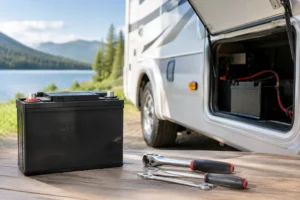
Use a properly sized DC-DC battery-to-battery charger with a LiFePO4 profile. It limits input current, applies the correct output voltage and works more reliably with modern smart alternators that reduce their output voltage after the starter battery is charged. In a motorhome, camper or 4×4 installation, the DC-DC charger’s current rating should be selected around alternator capacity, cable run, fuse protection and the house battery’s permitted charge current.
Marine systems need the same discipline. A high-output alternator, external regulator and LiFePO4 bank can work well together, but the design must include temperature monitoring, alternator protection and charging limits appropriate to the engine and battery bank.
Charge within the permitted temperature range
The most common LiFePO4 charging restriction is temperature. Standard LiFePO4 cells should not normally be charged below 0°C, even though they may be able to discharge at lower temperatures. Charging a cold cell can cause lithium plating, permanently reducing capacity and potentially damaging the battery.
Many batteries use a low-temperature cut-off in the BMS. If the BMS stops charging, do not bypass it or repeatedly force the charger to restart. Warm the battery naturally to the permitted charging range, or use a battery with integrated heating if winter use is expected. This is particularly relevant for externally stored motorhomes, boats on winter moorings and remote cabins.
High ambient temperatures also deserve attention. Keep batteries away from engine heat, direct sunlight and poorly ventilated lockers. The correct charge voltage will not compensate for an installation that operates continuously in excessive heat.
A practical charging routine
Start by checking battery voltage, connections and any BMS status indication. Confirm the charger profile before energising the system, then allow the charger to complete its normal lithium charging cycle. Occasional charging to 100% is useful where cell balancing occurs near the top of charge, but there is rarely a need to hold a LiFePO4 battery at 100% for weeks.
For a battery stored out of service, leave it partly charged rather than fully charged or flat. Around 40% to 60% state of charge is commonly suitable for storage, subject to the battery manual. Isolate non-essential loads, check the battery periodically and store it in a dry location within its stated temperature limits.
The best charging system is one designed as a complete electrical system: correctly matched battery, charger, solar controller, alternator charger, cabling and protection hardware. QuantEnergo technical support can help match those components to the real load profile of a boat, motorhome or off-grid installation. Set the profile once, protect the wiring properly and your LiFePO4 battery can spend its long working life delivering power rather than recovering from avoidable charging mistakes.


No comment yet, add your voice below!