

A battery that reaches 12.7V after charging can still be near the end of its useful life. If voltage falls rapidly under a water pump, inverter or bow thruster load, capacity has reduced, and repeated charging will not restore it. To replace lead acid batteries properly, treat the change as a system upgrade rather than a simple battery swap. Battery chemistry affects usable capacity, charging behaviour, cable protection and the performance you can expect from solar and alternator charging.
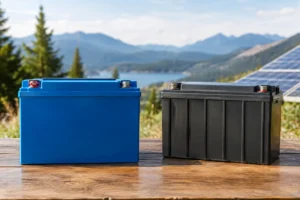
For motorhomes, boats and fixed off-grid systems, LiFePO4 is often the practical replacement choice. It offers more usable energy from the same rated capacity, lower weight, faster charging and a dramatically longer service life when correctly specified. The result can be more time away from shore power, less generator runtime and a battery bank that does not need replacing every few seasons.
When should you replace lead acid batteries?
Age alone is not the deciding factor, but it is a useful warning sign. Flooded, AGM and gel batteries gradually lose capacity through sulphation, deep discharges and normal cycling. A leisure battery may still start a small load but no longer support the daily energy demands of compressor refrigeration, lighting, laptops, heating controls and an inverter.
Common signs include a noticeably shorter runtime, voltage sag when loads start, slow charging, excessive heat during charging, swelling, acid smell or a battery that will not settle at a stable state of charge. A hydrometer test can help assess flooded cells, while a controlled capacity test is more useful for AGM and gel batteries. If a 100Ah lead-acid battery delivers only a fraction of its original energy before reaching its safe discharge limit, replacement is usually more economical than attempting repeated recovery charges.
Replacement also makes sense before failure if you are adding solar, installing an inverter, extending time off-grid or reducing weight in a caravan, campervan or sailing boat. An old lead-acid bank can become the limiting component in an otherwise capable charging system.
Why LiFePO4 changes the available capacity
A direct comparison of amp-hours can be misleading. A 100Ah lead-acid battery should generally not be routinely discharged below around 50% if long service life is the goal. That means only about 50Ah is comfortably available. A 100Ah LiFePO4 battery can commonly provide around 80-100Ah of usable capacity, depending on the battery management system settings and the operating conditions.
LiFePO4 voltage also stays more stable under load. This matters when running a compressor fridge, diesel heater, water pump or inverter. Lead-acid voltage can dip sharply as discharge increases, sometimes causing low-voltage alarms even though energy remains in the battery. A correctly designed LiFePO4 system holds useful voltage for longer and wastes less power as heat during charging.
Weight is another practical gain. In a motorhome or boat, replacing two heavy lead-acid leisure batteries with equivalent usable LiFePO4 capacity can release valuable payload. The smaller footprint can also make room for fuses, busbars, battery monitors or a larger solar controller.
The trade-off is that LiFePO4 batteries require the right charging profile and low-temperature protection. Quality batteries incorporate a battery management system, or BMS, to protect against over-charge, over-discharge, over-current and short circuit conditions. A BMS is protection, not a substitute for correctly rated cables, fuses and charging equipment.
Size the replacement battery from energy use
Start with the loads, not the old battery label. Calculate the energy consumed over a typical 24-hour period in watt-hours. A 60W compressor fridge operating for eight hours uses roughly 480Wh. Add lighting, pumps, device charging, heating electronics, television and inverter loads. Then allow a sensible reserve for poor weather, unexpected stops or longer anchorages.
For a 12V system, a 100Ah LiFePO4 battery stores approximately 1,280Wh nominally. In real use, inverter efficiency, cable losses, temperature and battery reserve reduce the energy available at the appliance. For modest weekend motorhome use with solar support, 100Ah may be sufficient. Full-time remote work, electric cooking support or several days at anchor can justify 200Ah or a 24V battery bank.
Higher voltage is particularly worthwhile where inverter power rises. At 12V, a 2,000W inverter can draw well over 170A once losses are included. At 24V, current is roughly halved, making cable sizing and voltage drop easier to manage. It depends on the existing equipment: retaining a 12V distribution system is often sensible for a simple upgrade, while a new off-grid installation may benefit from 24V storage from the outset.
Do not select battery capacity solely because it fits the existing battery tray. Confirm the physical dimensions, terminal layout, ventilation requirements of nearby equipment and the route for suitably sized cables. LiFePO4 batteries do not produce gas in normal operation like flooded lead-acid batteries, but a dry, protected and mechanically secure installation remains essential.
Check every charging source before fitting LiFePO4
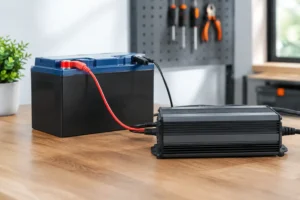
The most common problem when replacing lead acid batteries is leaving charging equipment unchanged without checking its settings. A modern mains charger, solar controller or inverter-charger may have a LiFePO4 profile, configurable absorption voltage and the ability to disable float or equalisation functions. These settings should match the battery manufacturer’s specification.
Lead-acid equalisation must never be applied to a LiFePO4 battery. Temperature-compensated lead-acid charging should also be reviewed, because LiFePO4 uses different temperature logic. Charging below 0°C can damage lithium cells unless the battery has low-temperature charge cut-off or integrated heating. This is especially relevant for winter motorhome storage, exposed battery lockers and marine installations in northern climates.
Solar charging is usually straightforward with an MPPT controller configured for LiFePO4. The panel array must still be sized to the controller’s voltage and current limits. If the battery is larger than the solar harvest, it will simply take longer to recharge. A 200Ah battery gives useful reserve, but it needs enough panel wattage or another charging source to recover daily consumption.
Alternator charging deserves special attention. LiFePO4 can accept high current for long periods, which may overload a vehicle alternator designed around lead-acid batteries that naturally reduce their charge acceptance. A DC-DC battery-to-battery charger limits current, provides the correct lithium charging profile and prevents the leisure bank from drawing excessively from the starter system. For many Euro 5 and Euro 6 vehicles with smart alternators, it is the correct engineering solution rather than an optional accessory.
A safe installation sequence
Before starting, document the existing system. Photograph cable routes and labels, identify every positive feed and confirm which circuits are protected by which fuse. Isolate shore power, solar input and alternator charging before disconnecting the old battery. Solar panels can remain live whenever there is daylight, so isolate the controller correctly rather than assuming the battery disconnect alone has made the system safe.
A reliable replacement installation should include these checks:
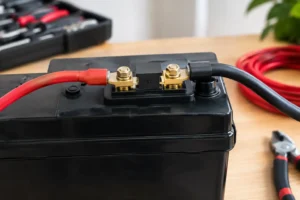
- Fit a correctly rated fuse close to the battery positive terminal for each major cable leaving the bank.
- Size cables for continuous current, peak inverter current and the actual cable run, not only the appliance rating.
- Use a main battery isolator and secure all cables against vibration, chafe and moisture.
- Install a shunt-based battery monitor where practical, as voltage alone is not a reliable state-of-charge reading for LiFePO4.
- Confirm charger, solar controller and DC-DC charger settings before reconnecting charging sources.
Never connect a new LiFePO4 battery directly in parallel with an old lead-acid battery. Their charging voltages, internal resistance and discharge behaviour differ. If more capacity is needed, use matched LiFePO4 batteries of the same model, age and state of charge, and follow the manufacturer’s instructions for parallel or series connection.
Do not overlook the inverter and protection hardware
A larger battery can reveal weaknesses elsewhere. When battery voltage no longer collapses under load, an inverter may be asked to run appliances for longer than before. Check its continuous rating, surge rating and low-voltage cut-off settings. A pure sine wave inverter is normally the appropriate choice for sensitive electronics, chargers and many motor-driven appliances.
Also inspect distribution fuses, negative busbars, battery switches and crimped terminals. Corroded marine connections or undersized campervan cables create resistance, heat and voltage loss regardless of battery chemistry. Good system performance comes from the complete path between generation, storage and loads.
Choose for the journey, not just the first weekend
The best time to replace lead acid batteries is before limited capacity dictates your plans. A correctly sized LiFePO4 battery bank, matched charging equipment and properly protected cabling turn solar generation and alternator time into usable independence. QuantEnergo can help match 12V or 24V storage, solar regulation, charging and inverter equipment to the space available and the loads you actually use.
Plan the battery around the places you want to stop, the weather you expect and the equipment you refuse to leave switched off. That is how an electrical upgrade becomes dependable freedom rather than another item on the maintenance list.




No comment yet, add your voice below!