

A battery bank that occupies half a motorhome locker, takes hours to recharge and delivers only part of its stated capacity changes how freely you can travel. The practical question in LiFePO4 versus AGM batteries is not simply which technology is newer. It is which one gives your RV, boat or off-grid installation the usable energy, charging speed and service life your system actually needs.
AGM batteries remain familiar, widely available and capable in the right application. LiFePO4 batteries, however, have become the preferred choice for many mobile and independent power systems because they provide more usable capacity from less weight, accept solar charge efficiently and can deliver thousands of cycles. The initial purchase price is higher, but the system-level result is often better value.
LiFePO4 versus AGM batteries at a glance
An AGM battery is a sealed lead-acid battery. Its electrolyte is held in absorbent glass mat separators, making it spill-resistant and largely maintenance-free. AGM has long been used for engine starting, backup power, caravans and marine installations because it is simple to source and compatible with conventional lead-acid chargers.
LiFePO4, or lithium iron phosphate, is a lithium battery chemistry designed for stable, deep-cycle energy storage. A quality LiFePO4 battery includes a battery management system, usually called a BMS. This monitors cell voltage, current and temperature, protecting the battery against conditions such as overcharge, excessive discharge and short circuits.
The critical difference is usable energy. A 100Ah AGM battery should normally be discharged to around 50% if long life is expected. That means approximately 50Ah is routinely available. A 100Ah LiFePO4 battery can commonly supply 80 to 100Ah, depending on its BMS settings and the manufacturer’s recommended discharge level. In practical terms, a 100Ah LiFePO4 unit can replace a substantially larger AGM bank for many leisure and off-grid loads.
Capacity, weight and installation space
Weight matters when every kilogram affects payload, trim or fuel consumption. A typical 100Ah AGM battery can weigh around 25 to 30kg. A comparable 12V 100Ah LiFePO4 battery is often closer to 10 to 13kg. Replacing two AGM batteries with a correctly specified lithium battery can therefore save 30kg or more.
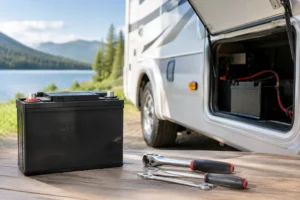
That reduction is valuable in a campervan with a limited garage compartment, an overland vehicle carrying water and recovery equipment, or a sailing boat where weight distribution affects handling. It can also simplify installation. One compact 12V LiFePO4 battery may fit where two lead-acid batteries and additional cabling previously occupied the space.
Do not select solely by amp-hours. Compare usable watt-hours. A nominal 12V 100Ah battery stores roughly 1,200Wh, but the amount you can draw repeatedly without shortening its life is very different between technologies. For a 24V system, calculate in the same way: multiply nominal voltage by amp-hours, then apply the recommended usable depth of discharge.
Voltage behaviour under load
AGM voltage falls progressively as the battery discharges, and it drops further under high loads. An inverter powering a coffee machine, induction hob or power tools may reach its low-voltage cut-off while the AGM battery still has energy remaining.
LiFePO4 maintains a flatter voltage curve through most of its discharge cycle. This helps inverters, compressors, diesel heaters and sensitive 12V equipment operate more consistently. The result is not extra magic capacity. It is more of the stored capacity being available at a useful working voltage.
Charging from solar, alternator and shore power
Charging performance is often where LiFePO4 changes an off-grid system most noticeably. AGM batteries accept strong charge current when heavily discharged, but absorption slows as they approach full charge. The final part of an AGM charge can take a long time, particularly with solar power during short winter days.
LiFePO4 batteries can generally accept a higher current for longer and recharge quickly when sufficient charging power is available. A correctly matched MPPT controller and solar array can recover a meaningful proportion of daily consumption before the next evening. This is especially useful for motorhome owners moving between pitches, boat owners relying on intermittent engine running, and remote workers who cannot wait all day for a battery bank to recover.
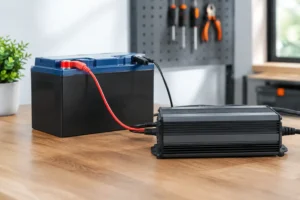
Compatibility still matters. A charger, solar controller or inverter-charger must have a LiFePO4 charging profile, or adjustable voltage settings that match the battery specification. Equalisation must be disabled. Temperature compensation used for lead-acid charging should not be applied unless the battery manufacturer specifically requires it.
Alternator charging needs particular attention. Older vehicle alternators and long cable runs can be stressed by a lithium battery that accepts high current for extended periods. A properly sized DC-DC charger limits current, supplies the correct charging profile and protects both the alternator and battery. This is not an optional detail for a serious campervan or 4×4 installation.
Lifespan and lifetime cost
AGM batteries commonly deliver several hundred deep cycles when discharged moderately and recharged correctly. Frequent deep discharge, partial charging and long periods left below full charge can reduce that figure quickly. Sulphation is a familiar lead-acid failure mode, particularly in seasonal vehicles stored without an appropriate maintenance charge.
Quality LiFePO4 batteries are designed for far more cycles. Products rated for 6,000 or more cycles can provide years of regular service in a solar-fed motorhome, boat or static off-grid system. Their lower self-discharge also makes them better suited to storage, although any battery should be isolated and maintained according to its technical manual during long lay-ups.
The purchase comparison therefore needs to include replacement frequency. AGM may cost less on day one, but a lithium battery can deliver more usable energy per cycle and may avoid multiple AGM replacements over the same period. For an occasional weekend caravan with modest lighting and water-pump use, AGM can still be economically sensible. For regular touring, liveaboard use, refrigeration or daily inverter loads, LiFePO4 usually has the stronger lifetime value.
Cold weather is the key LiFePO4 limitation
Lead-acid batteries lose capacity in cold conditions, but AGM can generally be charged below freezing, albeit less efficiently. Standard LiFePO4 cells should not be charged below 0°C unless the battery has protection that prevents it or an integrated heating solution designed for the purpose. Charging frozen lithium cells can cause permanent damage.
This does not make LiFePO4 unsuitable for winter travel. It means the installation must be designed honestly. Fit the battery within an insulated internal compartment where possible, select a battery with low-temperature charge protection, and consider a heated LiFePO4 model for vehicles and boats exposed to sub-zero temperatures.
Discharging LiFePO4 in cold weather is normally possible, though capacity and performance reduce as temperatures fall. Check the battery’s specified operating range rather than assuming all lithium products behave identically.
When AGM remains the right choice
AGM is not obsolete. It remains a practical choice where budget is very limited, use is occasional, charging equipment cannot reasonably be upgraded, or the battery must operate in an environment where sub-zero charging is unavoidable. It can also suit engine starting duties, although a dedicated starting battery should be selected according to cranking requirements rather than deep-cycle capacity.
AGM may be the simpler replacement if a small caravan has a basic lead-acid charger, no inverter and only a few days of lighting, pump and USB charging demand. In that situation, spending more on lithium without improving solar input or charging hardware may not solve the real limitation.
Choosing the correct LiFePO4 battery size
Start with daily consumption, not the capacity of the battery you are replacing. Add the watt-hours used by refrigeration, lighting, fans, water pumps, laptops, routers, television and inverter loads. Divide by your system voltage to estimate amp-hours, then allow a sensible reserve for poor solar days.
A compact 12V 30Ah LiFePO4 battery may suit low-demand portable power. A 100Ah unit is a common starting point for weekend campervan use with a compressor fridge and modest solar. For extended motorhome travel, liveaboard loads or regular inverter use, 150Ah to 200Ah at 12V, or a correctly designed 24V bank, may be the more realistic choice.
Also check continuous discharge current. Battery capacity tells you how long the battery can run a load; the BMS discharge rating tells you whether it can start and sustain that load. A 2,000W inverter on a 12V system can require well over 160A once losses are considered. Cable size, fusing, isolation and inverter surge demand must all be designed accordingly.
The best battery is the one that fits the full system: available installation space, solar harvest, alternator charging, inverter power and expected daily consumption. For a properly matched upgrade, QuantEnergo technical support can help turn those figures into a safe 12V or 24V system that gives you dependable power well beyond the next campsite or marina.


No comment yet, add your voice below!