

A leisure battery can be fully charged by solar while parked, then slowly fall behind during a wet touring week or a long engine run. That is where a DC to DC charger for lithium battery systems earns its place. It takes variable power from a vehicle alternator and delivers a controlled charging profile that a LiFePO4 battery can use safely and efficiently.
For motorhomes, campervans, 4x4s and boats, this is not simply a faster way to charge. It is protection for the starter battery and alternator, a dependable charging source when solar output is limited, and a way to preserve the long service life expected from a quality lithium installation.
What a DC to DC charger does in a lithium system
A DC to DC charger sits between the vehicle starter battery or alternator and the leisure battery bank. Rather than connecting the two batteries through a basic split-charge relay, it regulates the input and supplies the correct multi-stage voltage to the lithium battery.
LiFePO4 batteries accept high charge currents for much longer than lead-acid batteries. This is one reason they recharge quickly, but it can also place excessive demand on an alternator if charging is not controlled. A properly specified charger limits that draw to its rated input current and prevents the leisure battery from pulling uncontrolled current directly from the vehicle electrical system.
The charger also boosts or stabilises voltage where necessary. Long cable runs, modern smart alternators and voltage drop can leave a leisure battery undercharged with a conventional relay. A DC to DC unit is designed to work with these conditions, provided the wiring, fusing and settings are correct.
Why a split-charge relay is usually not enough
A voltage-sensitive relay has a place in simple lead-acid installations. It joins the starter and leisure batteries once the engine is running, with little control over the charging process. That approach becomes less suitable when upgrading to LiFePO4.
Lithium batteries generally require a specific absorption voltage, no equalisation stage, and a suitable low-temperature charging strategy. More importantly, their low internal resistance can allow very high alternator current. On an older vehicle with a conventional alternator and a small lithium battery, a relay may appear to work. It can still run the alternator hotter than intended, reduce charge consistency and offer limited protection against starter-battery discharge.
A DC to DC charger costs more and introduces another component, but it provides a defined current limit and a lithium-compatible programme. For a vehicle used regularly away from hook-up, that is a sensible trade-off.
Choosing the right DC to DC charger for lithium battery capacity
Start with system voltage. A 12V leisure battery requires a 12V-to-12V charger, while a 24V battery bank normally needs a charger designed to accept the vehicle input voltage and produce the required 24V output. Never assume that a 12V charger can be adapted to charge a 24V bank simply by changing cabling.
Then select charging current. A 20A charger is often appropriate for compact 30Ah to 100Ah LiFePO4 installations where alternator capacity and cable size are limited. A 30A or 40A model can be a better fit for a 100Ah to 200Ah battery bank used for compressor refrigeration, inverter loads or extended off-grid travel.
Battery capacity alone should not decide the rating. A larger charger can reduce driving time needed to recharge the bank, but only if the alternator can support the extra load. Consider the vehicle’s standard electrical demand, starter battery condition, alternator output, engine idle time and cable route. A 40A charger on a system with undersized cables or a marginal alternator is not an upgrade.
As a practical example, a 100Ah LiFePO4 battery discharged by 50Ah needs roughly 50Ah returned, plus normal charging losses. A 20A charger may recover most of that energy during a three-hour drive. A 40A unit could do it in substantially less time, but the installation must be engineered for the higher current.
Match the charger to the alternator, not its headline rating
An alternator marked 150A does not necessarily have 150A continuously available for leisure charging. Its output changes with engine speed and temperature, while headlights, heating blowers, engine management and vehicle charging systems take their share.
Modern Euro 5 and Euro 6 vehicles frequently use smart alternators that reduce voltage when the starter battery is considered charged. Choose a charger with an ignition or D+ trigger input where required. This tells the unit to operate only when the engine is running, avoiding unwanted discharge of the starter battery when parked.
Some chargers offer variable current settings. This can be valuable where a 40A-capable model is needed for a future battery upgrade but should initially be limited to 20A or 30A to suit the vehicle.
Lithium charging profile and temperature protection
Confirm that the charger has a dedicated LiFePO4 profile, either pre-set or configurable to the battery manufacturer’s recommended voltage. Typical 12V LiFePO4 charging voltage is around 14.2V to 14.6V, but settings must follow the battery specification. Do not use lead-acid equalisation or desulphation modes with lithium batteries.
Low-temperature charging is equally important. LiFePO4 cells should generally not be charged below 0°C unless the battery has an approved internal heating system or the battery management system permits it. A charger with a temperature sensor or low-temperature inhibit provides an additional layer of protection, especially in winter motorhome use, unheated lockers and marine installations.
The battery BMS remains the final safety control, but it should not be treated as the normal method of regulating charge. Configure the charger correctly so the BMS is not repeatedly disconnecting under ordinary operating conditions.
Wiring, fuses and cable sizing determine performance
Even the best charger cannot overcome poor wiring. DC charging operates at high current, and voltage drop quickly becomes significant on a 12V system. Position the charger as close as practical to the leisure battery, while keeping it in a dry, ventilated location away from direct engine-bay heat unless it is specifically rated for that environment.
Use cable sized for the charger’s current rating and the total cable length, including both positive and negative paths. The longer the route from starter battery to charger and charger to leisure battery, the larger the conductor normally needs to be. A voltage drop that looks minor on paper can prevent a lithium battery reaching its intended charge voltage.
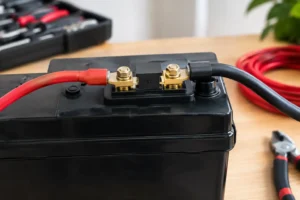
Fit correctly rated fuses close to both battery positive terminals. The starter-battery-side fuse protects the cable running towards the charger; the leisure-battery-side fuse protects the output cable. Fuse ratings must protect the cable while accommodating normal charger current. If in doubt, obtain a calculation for the cable size, route and installation environment rather than copying a generic wiring diagram.
A dedicated negative return cable is usually preferable to relying on chassis earth alone, particularly in marine systems and higher-current vehicle builds. Boats require additional care with corrosion resistance, tinned cable, termination quality and applicable electrical standards.
Combined alternator and solar charging
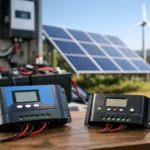
Many off-grid vehicles use alternator charging as one part of a wider system. Solar provides quiet daytime recovery, while the DC to DC charger restores energy during driving. A separate MPPT solar controller gives the best flexibility when panel voltage, roof space and solar array size are key design factors.
Combination units that include an MPPT solar input can save space and simplify wiring in compact campervans. They are a good choice where one panel array and one battery bank are planned. Separate components can be better for larger systems, unusual panel configurations, or installations where solar and vehicle charging need to be expanded independently.
For a 12V or 24V LiFePO4 bank, make sure all charging sources use compatible voltage settings. The alternator charger, MPPT controller, mains charger and hybrid inverter charger should not be working to conflicting absorption or float values.
A practical specification check before ordering
Before selecting equipment, record the battery voltage and capacity, alternator type, expected daily loads, maximum driving hours, cable route length and available mounting space. Also identify whether you need an ignition trigger, Bluetooth monitoring, solar input or low-temperature protection.
For example, a 12V 100Ah battery in a campervan with a smart alternator, 200W of roof solar and a compressor fridge may suit a 20A to 30A lithium DC charger with D+ control. A 24V 200Ah off-grid service bank on a work vehicle needs a more specialised voltage configuration and a careful alternator-load assessment. The correct answer depends on the complete system, not just the battery label.
QuantEnergo supports system builders who want the battery, solar regulation, inverter and protection hardware to work as one installation. Choose the charger as part of that electrical plan, and every mile travelled becomes useful charging time rather than a missed opportunity for energy independence.




No comment yet, add your voice below!