

A battery that looks generous on paper can still leave a boat without power at the wrong moment. The issue is usually not chemistry but system matching: insufficient usable capacity, an undersized BMS, a charger with the wrong profile, or a battery bank that cannot supply the inverter’s peak current. The best lithium battery for a boat is therefore the LiFePO4 battery that fits the vessel’s real loads, charging sources and available installation space.
For most cruising boats, LiFePO4 is the practical replacement for lead-acid domestic batteries. It provides high usable capacity, stable voltage under load, low weight for the energy stored and a long working life that can exceed 6,000 cycles when correctly specified and charged. But a 12V 100Ah battery is not automatically the right answer for every cabin cruiser, sailing yacht or electric tender.
Why LiFePO4 suits marine domestic power
A conventional lead-acid bank should generally not be deeply discharged if long service life is expected. A 100Ah lead-acid battery may therefore offer far less than 100Ah of routinely usable energy. A 100Ah LiFePO4 battery can usually provide around 80 to 100Ah of usable capacity, depending on the configured low-voltage protection and operating conditions.
LiFePO4 also maintains a more stable voltage while supplying loads. That matters when running a compressor fridge, chartplotter, water pump, lighting, diesel heater controls and USB charging from one domestic bank. Voltage sag is reduced, so equipment is less likely to shut down simply because a high-demand appliance has started.
Weight is another marine advantage. Replacing a large lead-acid bank with lithium can remove significant mass from the boat, particularly where batteries are mounted low and centrally. The saving is useful, but it should not be the only reason to change chemistry. Safe charging integration and suitable over-current protection remain essential.
Best lithium battery for a boat: start with daily demand
Capacity should be selected from an energy audit, not from the old battery label. List every load likely to operate over a normal 24-hour period, estimate its wattage and hours of use, then calculate watt-hours. Divide the result by nominal battery voltage to establish approximate amp-hour demand.
A 12V compressor fridge consuming 45W for eight hours over a day uses roughly 360Wh. Add cabin lighting, navigation electronics, mobile phone charging, a pressure pump and occasional laptop charging, and a modest boat can easily require 700 to 1,200Wh daily. At 12V, that is approximately 60 to 100Ah before allowing for inverter losses, cloudy weather or an extra night at anchor.
For a lightly used day boat, a 12V 30Ah or 50Ah LiFePO4 battery may suit electronics, lighting and a small auxiliary load. For a weekend cruiser with a fridge, a 100Ah battery is often the sensible starting point. A boat spending several days away from shore power, especially with a fridge, heater, larger inverter or electric cooking appliances, may need 200Ah or more.
Do not size the bank to cover only an ideal sunny day. Solar yield changes with season, shading from rigging and mooring orientation. Build in reserve for poor charging days and increased consumption during longer passages or cooler weather.
Think in watt-hours when comparing 12V and 24V
Amp-hours alone can mislead. A 12V 200Ah battery stores about 2,560Wh, while a 24V 100Ah battery stores roughly the same energy. The 24V battery does not create extra energy, but it delivers that energy at half the current.
Lower current means smaller voltage losses in cable runs and more manageable demands on fuses, switches and connectors. This is particularly valuable when an inverter is central to the onboard system. A 2,000W inverter can draw well over 170A from a 12V battery bank at high load, but around 85A from a 24V bank. For high-output inverters, 24V is often the more efficient and practical architecture.
Choose 12V for simplicity, 24V for higher power
A 12V LiFePO4 system remains the natural choice for many small and medium boats. Navigation electronics, pumps, lighting, VHF radios and many fridges are designed for 12V DC. A 12V battery also makes lead-acid replacement more straightforward where the existing charging equipment can be updated or configured for LiFePO4.
A 24V system is worth serious consideration on larger vessels, boats with long cable runs, substantial inverter loads, electric propulsion auxiliaries or high-output solar charging. It can reduce cable size requirements and makes a 2,000W to 3,000W inverter installation more realistic. The trade-off is that 24V DC equipment may be required, or 24V-to-12V DC-DC conversion must be added for legacy loads.
Avoid building a 24V bank by permanently connecting two unrelated 12V batteries in series unless the batteries are identical, the installation is designed for series operation and the manufacturer permits it. A purpose-built 24V LiFePO4 battery reduces balancing complications and makes monitoring clearer.
The BMS rating matters as much as capacity
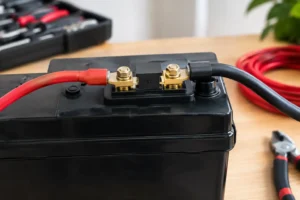
Every quality LiFePO4 battery should include a battery management system, or BMS. It protects cells from over-charge, excessive discharge, over-current and unsafe temperatures. However, BMS protection is not a substitute for correctly sized fuses, cable and isolation hardware.
Check both continuous and peak discharge current. A 100Ah battery with a 100A BMS can theoretically support around 1,200W at 12V before losses, but it is not the right choice for repeated high-power inverter demand. A kettle, induction hob, hairdryer or power tool can exceed that limit immediately and trigger BMS protection.
Also assess charge-current capability. If the boat has a powerful alternator, shore charger or solar array, the battery must accept the planned charging current. Charging too aggressively can cause a BMS disconnect, while charging too slowly may leave the bank undercharged during limited running time.
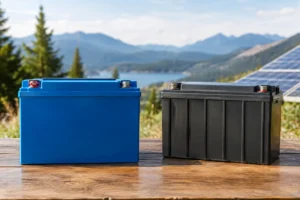
For marine use, choose a battery with clear electrical specifications, integrated protection and a case suited to vibration. Install it in a dry, secure location away from direct bilge water, engine heat and loose gear. LiFePO4 batteries do not require venting like flooded lead-acid batteries, but they still need a clean, accessible and mechanically secure mounting position.
Charging equipment decides whether the upgrade performs
A lithium battery performs properly only when its charging sources are configured for LiFePO4. That includes the shore-power charger, alternator charging arrangement and solar controller.
A modern mains charger should offer a LiFePO4 profile or programmable voltage settings. It should not depend on a long lead-acid absorption cycle or an equalisation mode. Equalisation must never be used with a LiFePO4 battery.
Alternator charging requires particular care. Lithium batteries can accept high current for a long period, which may overload a standard alternator that was previously charging lead-acid batteries. A suitably rated DC-DC charger, often with alternator temperature protection, controls current and provides the correct charging profile. This is one of the most valuable upgrades on an engine-powered boat.
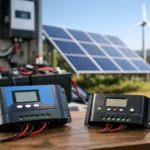
Solar is an excellent match for LiFePO4 because the battery accepts charge efficiently. An MPPT controller is normally the stronger choice where panel voltage and available roof or deck space allow it, particularly with larger arrays. Match the controller’s current rating to the solar array and battery voltage, and install correctly rated isolation and fuse protection between panels, controller and battery.
QuantEnergo systems are designed around this full installation logic: LiFePO4 storage, solar generation, MPPT regulation, charging and inverter equipment selected as compatible parts rather than as isolated purchases.
Do not forget cold-weather charging and battery monitoring
LiFePO4 batteries can discharge in cold conditions, but charging below freezing can damage the cells unless the battery has low-temperature charge protection or integrated heating. This is relevant for boats wintering afloat, stored ashore in unheated yards, or used in northern cruising areas.
Confirm the permitted charging temperature in the battery specification. If sub-zero charging is possible, choose a model with suitable BMS protection and plan the battery location accordingly. Never assume that a battery will be warm enough simply because it is inside the cabin.
A proper battery monitor with a shunt is also worthwhile. Voltage alone is a poor indication of lithium state of charge because LiFePO4 voltage remains comparatively flat through much of its discharge range. A shunt-based monitor records current in and out, helping the skipper understand actual consumption, solar contribution and remaining capacity.
A practical specification approach
For a 12V boat with a fridge, lighting, pumps, navigation equipment and occasional inverter use, a 100Ah to 200Ah LiFePO4 domestic battery bank with a suitably rated BMS is normally the useful range. Pair it with a LiFePO4-compatible shore charger, an alternator-safe DC-DC charger and solar regulated through an MPPT controller.
For a boat relying on a larger inverter or carrying higher daily consumption, consider a 24V battery system from the outset. The initial design may involve more planning, but reduced current and improved inverter efficiency can make the installation safer and easier to scale.
The right battery is the one that still has reserve after a grey day, a long evening at anchor and a fridge working hard in summer. Start with measured demand, specify protection and charging equipment around it, and the electrical system becomes a dependable part of the voyage rather than another reason to return to shore.



No comment yet, add your voice below!