

A 300W inverter can be perfect for charging a laptop and camera batteries, yet completely unsuitable for a 900W coffee machine. That is why the answer to what size inverter for a campervan is never simply “buy the biggest one”. An inverter must match your real AC loads, your battery bank, cable runs and charging capacity. Oversizing wastes standby power and installation budget; undersizing leads to overload alarms, nuisance shut-downs and equipment that cannot start.
For most campervans, a 1,000W to 2,000W pure sine wave inverter is the practical working range. The correct choice depends on what you intend to run at the same time and whether your 12V or 24V battery system can safely deliver the required current.
What size inverter for a campervan load?
Start with the appliances that genuinely need 230V AC power. Many campervan loads are better supplied directly from 12V or USB-C: lights, water pumps, compressor fridges, fans, routers and phone charging all avoid inverter losses when they run on DC. Reserve the inverter for appliances that only have a mains plug.
Check each appliance label for its rated wattage. Add together the appliances likely to operate simultaneously, then allow a sensible margin of around 20 to 30 per cent. This margin covers measurement uncertainty, battery-voltage drop and the fact that some equipment draws more power than its label suggests during normal operation.
A typical remote-work and touring setup may include a 100W laptop charger, 60W monitor, 100W camera battery charger and 800W small appliance. If the highest realistic combined load is 1,060W, a 1,500W inverter gives useful headroom. A 1,000W unit would be too close to its continuous rating.
Do not size an inverter around rare, unrealistic combinations. If the induction hob, hair dryer and kettle would only ever be used one at a time, calculate for the largest of those loads plus any equipment that will remain on. Good power management can reduce the inverter and battery size required.
Continuous power is not surge power
Inverters have a continuous power rating and a short-duration peak or surge rating. Continuous power is the figure that matters for a kettle, heater, microwave or power tool used for more than a few seconds. Surge power helps start loads with motors, compressors or transformers, including some power tools and older battery chargers.
A 1,500W inverter with a 3,000W surge rating does not run a 2,500W kettle. It may briefly support a motor starting, but it cannot deliver 2,500W continuously. Always compare appliance running wattage with the inverter’s continuous rating, then check that motor-driven equipment falls within its stated surge capability.
Typical campervan inverter sizes
A 300W to 600W pure sine wave inverter suits light electrical use. It can power laptop chargers, camera chargers, a small television, a compact CPAP machine or modest workshop chargers. It is a sensible choice where the van primarily uses 12V equipment and the inverter is an occasional convenience.
A 1,000W to 1,500W inverter is often the best quality-to-capacity balance for a self-built campervan. It supports several electronic devices, many compact kitchen appliances used individually, and moderate power-tool charging. It still demands serious cabling on a 12V system, but it remains realistic with a correctly specified LiFePO4 battery bank.
A 2,000W inverter is appropriate for higher-demand touring, regular off-grid work or an electrical system designed around appliances such as a microwave, coffee machine or induction hob. It requires more than simply fitting a larger inverter. Battery discharge current, BMS limits, fuse ratings, cable cross-section and charging input all need to be designed for it.
Inverters above 2,000W can work well in large motorhomes and purpose-built off-grid vehicles, particularly on 24V systems. In a compact 12V campervan, they can become inefficient and demanding unless supported by a substantial battery bank, short heavy-duty cables and a charging system capable of replacing the energy used.
Calculate battery current before buying
The inverter takes low-voltage DC power from the battery and converts it to 230V AC. That voltage step-up means high current on the battery side. Use this practical calculation:
Battery current (A) = appliance power (W) ÷ battery voltage (V) ÷ inverter efficiency
Assume around 90 per cent efficiency for a good pure sine wave inverter under load. A 1,500W AC load on a 12V battery system therefore needs approximately 139A: 1,500 ÷ 12 ÷ 0.9. At 24V, the same load needs roughly 69A.
This is why system voltage matters. A 2,000W inverter on 12V can draw close to 185A at full output, and current may be even higher as battery voltage falls. A 24V battery system halves the current for the same AC load, making cable sizing, voltage drop and inverter operation easier to manage.
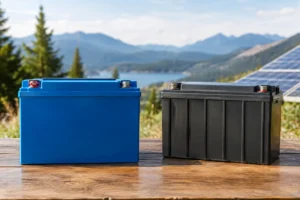
Check the battery’s continuous discharge specification and the BMS discharge limit. A LiFePO4 battery may have ample stored energy in amp-hours but still be unsuitable if its BMS cannot continuously supply the inverter current. For example, a 12V 100Ah battery with a 100A BMS limit should not be expected to sustain a 1,500W inverter at maximum output.
Battery capacity determines runtime, not inverter size alone. A 12.8V 200Ah LiFePO4 battery stores about 2,560Wh of nominal energy. After allowing for inverter losses and avoiding unnecessary deep discharge, a 1,000W appliance may run for roughly two hours, while a 100W laptop load can run far longer. High-wattage heating appliances consume stored energy rapidly, regardless of inverter quality.
Choose pure sine wave for dependable AC power
For campervan installations, choose a pure sine wave inverter rather than a modified sine wave model. Pure sine wave output is compatible with sensitive electronics, modern chargers, medical equipment, audio devices and appliances with variable-speed motors. It also reduces the risk of humming, excess heat and unreliable charger behaviour.
The inverter should have low-voltage protection, overload protection, thermal protection and a suitable remote on/off option where the unit is installed out of reach. Idle consumption is also worth checking. An inverter left switched on all day can use meaningful battery capacity even when no appliance is connected.
An inverter-charger can be a strong option for vans that regularly connect to campsite hook-up. It combines an inverter with a mains battery charger and may provide automatic transfer between shore power and battery power. It costs more and requires careful AC installation, but it creates a cleaner system for frequent touring.
Cables, fuses and installation are part of the rating
A correctly sized inverter can still fail if connected with undersized cable. At 12V, even a small amount of resistance causes voltage drop under heavy load. The inverter may alarm for low battery voltage while the battery itself is healthy, simply because the cable run is too long or too light.
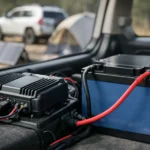
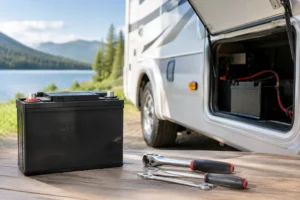
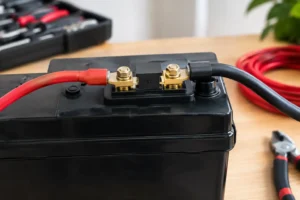
Mount the inverter close to the battery bank, in a dry and ventilated area, while following the manufacturer’s clearance requirements. Use correctly rated DC cables, crimped terminals, a fuse or circuit breaker positioned close to the battery positive terminal, and a battery isolator suitable for the expected DC current. Never select protection hardware using only the inverter’s AC wattage; its DC current rating is the critical figure.
The AC side also needs proper protection and installation practice. If you are supplying fixed sockets or integrating hook-up power, use appropriately rated cable, RCD protection and qualified support where required. A campervan electrical system is mobile, exposed to vibration and often operated in damp conditions, so workmanship matters as much as component specification.
Match inverter power to solar and charging
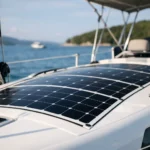
Solar panels do not need to equal inverter wattage. A 2,000W inverter can run from a battery charged by 400W of solar, but it cannot run at 2,000W indefinitely from that solar input. The battery covers short high loads; solar, DC-DC charging and mains charging replace the energy afterwards.
Consider your energy balance over a full day. A 1,200W coffee machine used for five minutes consumes around 100Wh before conversion losses. A 1,500W induction hob used for 30 minutes consumes around 750Wh. Those loads are possible with LiFePO4 storage, but they should be planned alongside available roof space, MPPT controller capacity and alternator charging limits.
For a dependable system, specify the inverter as one component of the complete power chain: battery, BMS, solar panels, charge controller, charging source, cables and protection. QuantEnergo technical support can help match these components where a campervan has limited space or higher AC demand.
The right inverter is the smallest pure sine wave unit that comfortably supports your genuine simultaneous load, starts the equipment you use and stays within your battery and cable limits. Choose that figure first, then build the rest of the system to deliver it safely.

No comment yet, add your voice below!