

A LiFePO4 battery charger is not simply a box that puts energy back into a battery. In an RV, motorhome, boat or off-grid installation, it determines how quickly your stored power is restored from shore supply or a generator, how accurately the battery is charged, and whether its long cycle life is protected. A charger designed for lead-acid batteries may appear to work, but its voltage stages and maintenance behaviour are not always suitable for lithium iron phosphate cells.
For a system built around dependable autonomy, select the charger as carefully as the battery, solar controller and inverter. The right unit must match the battery bank voltage, provide an appropriate lithium charging profile, deliver useful current without exceeding battery limits, and suit the available AC supply.
Start with battery bank voltage
The first decision is non-negotiable: charger output voltage must match the nominal battery bank voltage. A 12V LiFePO4 battery requires a 12V lithium charger, while a 24V bank requires a 24V lithium charger. Connecting a 12V charger to a 24V bank will not charge it properly. A 24V charger connected to a 12V battery can cause a BMS protection trip or, in the worst case, damage equipment.
A typical 12V LiFePO4 battery has a charging voltage around 14.2V to 14.6V. A 24V battery bank generally requires around 28.4V to 29.2V. Exact values depend on the battery manufacturer and BMS specification, so the battery data sheet takes priority over generic settings.
Do not choose by nominal voltage alone where multiple batteries are installed. Two 12V batteries in series form a 24V bank and need a 24V charger. Batteries in parallel remain a 12V bank, but their combined capacity rises, which affects the sensible charging current.
Why a dedicated LiFePO4 battery charger matters
Lithium iron phosphate batteries use a different charging approach from flooded, AGM and gel lead-acid batteries. They do not need prolonged absorption charging or a continuous high-voltage float phase. They also must not receive equalisation charging, a high-voltage process used on some lead-acid systems.
A proper LiFePO4 battery charger follows a controlled constant-current and constant-voltage process. It supplies its rated current until the battery approaches its set charging voltage, then reduces current as the battery completes the charge. When charging is complete, it should stop, enter a low standby state, or use a lithium-appropriate maintenance voltage if specified by the battery supplier.
This profile matters in practical use. A motorhome parked on electric hook-up for weeks, or a boat connected to marina power between trips, should not be held at an unsuitable charging voltage indefinitely. Lithium chemistry tolerates partial state of charge well, and a correctly configured charger avoids treating the battery like a lead-acid bank that needs permanent float charging.
A multi-stage lead-acid charger can only be used if it has a genuine LiFePO4 mode with suitable voltage settings and equalisation disabled. A label saying “smart charger” is not enough. Check the stated lithium profile, bulk or absorption voltage, float setting, and whether the charger can be configured for LiFePO4 chemistry.
Low-temperature charging protection
Lithium batteries should not be charged below 0°C unless the battery has a heating system or a BMS specifically designed to manage this condition. Charging cold cells can cause permanent internal damage, even if the battery still accepts power.
Many quality LiFePO4 batteries include low-temperature charge protection in the BMS. When cells are too cold, the BMS disconnects charging until their temperature rises to a safe range. This protection is valuable, but it should not be mistaken for a reason to ignore installation conditions. For a winter motorhome, an exposed locker, or a boat stored ashore, consider whether the battery location needs insulation, heating or a heated battery solution.
Size the charging current for capacity and use
Charger current is measured in amps. Higher current means faster charging, but the largest charger is not automatically the best choice. It must remain within the battery’s permitted continuous charge current and fit the AC supply, cabling and expected charging opportunity.
As a practical starting point, a charging rate of around 0.2C is efficient and gentle for many LiFePO4 installations. “C” refers to battery capacity. For example, 0.2C for a 100Ah battery is 20A. A 20A charger can therefore replenish a 100Ah 12V battery at a sensible rate, while a 40A charger will reduce charging time if the battery BMS and installation allow it.
A 30Ah battery used for a compact solar-powered leisure system may be well served by a 5A to 10A mains charger. A 100Ah RV battery often benefits from 20A to 30A charging. For a 200Ah bank supporting an inverter, compressor fridge, remote work equipment or longer stays away from hook-up, 40A to 60A may be appropriate. These are selection guides, not universal limits. Always verify the battery’s maximum recommended and maximum permitted charge current.
Charging time is also affected by depth of discharge. A 100Ah battery discharged to 20% state of charge needs roughly 80Ah returned, plus charging losses. With a 20A charger, expect approximately four to five hours rather than assuming a perfect four-hour result. Near-full charging naturally slows as the charger holds the final voltage and current tapers.
There is a trade-off. A smaller charger costs less, draws less from a limited campsite supply and can be easier to wire. A larger charger is valuable when a generator runs for a short period, when shore power is only available overnight, or when the system has heavy daily consumption. The correct size follows your actual energy use and recharge window.
Check AC input, DC cabling and protection
For UK and European travel, confirm that the charger accepts the AC supply you will use. Most fixed installations require 230V AC compatibility, while some mobile equipment may need a wider input range for variable generator output or continental hook-up supplies. A charger with power-factor correction can be advantageous in higher-power installations because it uses the AC supply more efficiently and can reduce nuisance issues with limited generators.
The charger’s DC output cable must be sized for its current and cable run. Undersized cable creates voltage drop, heat and slower effective charging. Keep the charger close to the battery bank where possible, while following ventilation requirements and avoiding locations exposed to water, fuel vapours or excessive engine-bay heat.
Fit a correctly rated fuse or circuit breaker in the positive cable near the battery. The protection must be selected for the cable capacity and expected charger current, not merely copied from another circuit. Isolation is equally useful for servicing and fault finding.
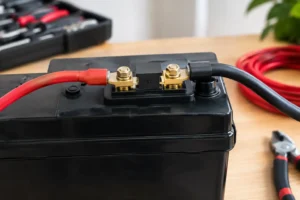
In marine and mobile installations, secure all cables against vibration and use suitable terminals, crimping tools and strain relief. A high-quality charger cannot compensate for loose lugs, corroded connections or a negative return path that is too small for the current.
Coordinate shore charging with solar and alternator charging
Most independent power systems have more than one charging source. Solar panels feed the battery through an MPPT or PWM charge controller, an alternator charger may charge while driving, and an AC LiFePO4 charger takes over when connected to shore power or a generator. These sources can coexist if each is configured for the battery voltage and lithium charging limits.
The key figure is total potential charge current. A 40A mains charger, 30A solar controller and 40A DC-to-DC alternator charger could theoretically supply 110A at once. The BMS must be rated to accept that current, and the battery manufacturer’s charging limit must not be exceeded. In reality, solar output varies and alternator charging may taper, but system design should account for the highest credible combined input.
Some installations also need a charger with a remote enable input, ignition control or communication capability. These features are useful where a battery BMS should control charging, where a generator is automated, or where the electrical system is monitored from a central display. For a simple campervan conversion, a reliable lithium-profile charger with clear status LEDs may be all that is needed.
Common charger selection mistakes
The most frequent error is retaining an old lead-acid charger without checking its settings. Equalisation, aggressive float voltage and temperature compensation designed for lead-acid batteries should not be applied blindly to LiFePO4. Another mistake is selecting by advertised wattage rather than output voltage and charge current.
Avoid charging a lithium battery through a basic unregulated workshop charger. Also avoid assuming a battery BMS replaces correct charger configuration. The BMS is a final safety layer that can disconnect for over-voltage, low temperature or excess current. Repeatedly forcing it to intervene is not good operating practice.
For larger systems, do not overlook the inverter-charger option. An inverter-charger combines AC battery charging with inverter functionality and can simplify an RV, marine or off-grid build. It is a strong choice where AC loads are central to the installation, but a separate charger and inverter can be more flexible when upgrading an existing 12V or 24V system.
QuantEnergo can help match charger current, battery capacity, solar regulation and inverter demand before equipment is installed. That planning is particularly worthwhile when replacing lead-acid batteries in an existing motorhome or boat, where original wiring and charging hardware may set the real limits.
A well-selected charger should disappear into the routine of the system: connect shore power after a wet weekend on the water, return from a long drive, or start a generator at a remote site, and the battery bank recovers predictably. Get the voltage profile, current rating and installation details right, and the battery is ready to deliver the long-life performance that makes LiFePO4 worth fitting in the first place.





No comment yet, add your voice below!