

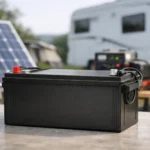
A 12V 100Ah LiFePO4 battery is often the point where an off-grid electrical system becomes genuinely useful rather than merely convenient. At roughly 1,280Wh of nominal stored energy, it can cover a full evening of lighting, water pumping, refrigeration and device charging in a motorhome, yacht or remote cabin – provided the charging system and cable protection are specified correctly.
For many owners replacing lead-acid leisure batteries, 100Ah is the practical middle ground. It provides meaningful capacity without demanding the installation space, weight or budget of a larger bank. The right choice still depends on your loads, charging sources, travel pattern and whether your system needs to run high-power AC equipment.
What a 12V 100Ah LiFePO4 battery delivers
A 12V LiFePO4 battery is normally built from four lithium iron phosphate cells, producing a nominal voltage of 12.8V. At 100Ah, the nominal energy calculation is straightforward:
12.8V × 100Ah = 1,280Wh, or 1.28kWh.
This figure is more useful than amp-hours when comparing it with appliances, because most loads are rated in watts. LiFePO4 chemistry also maintains a steadier voltage under load than lead-acid batteries. A compressor fridge, diesel heater fan or 12V water pump therefore receives more consistent power as the battery discharges.
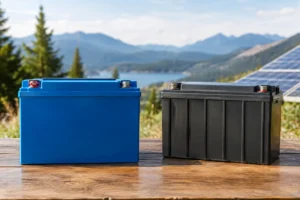
Compared with a typical 100Ah AGM or flooded leisure battery, a LiFePO4 unit can usually provide substantially more usable energy. Lead-acid batteries last longer when routinely discharged only to around 50 per cent, while lithium iron phosphate batteries are designed for much deeper regular discharge. The exact usable capacity should always follow the battery manufacturer’s discharge and battery-management-system specifications.
Weight is another major gain for mobile installations. A 100Ah LiFePO4 battery is commonly far lighter than an equivalent lead-acid unit. That matters in caravans, motorhomes and sailing boats, where every kilogram affects payload, trim and available storage space.
Match battery capacity to real daily consumption
A 100Ah battery is not automatically enough for every installation. Start with daily energy demand, then size the battery around the time you expect to spend away from mains power or engine charging.
A 45W compressor refrigerator running for eight hours across a day consumes about 360Wh. Add LED lighting at 40Wh, a water pump at 60Wh, mobile phone and laptop charging at 180Wh, plus a diesel heater fan at 120Wh, and the daily total reaches roughly 760Wh. A 1,280Wh battery can support that profile for about a day with sensible reserve capacity, or longer when solar generation is contributing.
High-power AC loads change the calculation quickly. A 1,000W kettle may only run for a few minutes, but it draws around 85A or more from a 12V battery once inverter losses are included. Hair dryers, coffee machines, induction hobs and electric heaters can exceed the continuous current capability of some 100Ah batteries. They also require an inverter, cables, fuse and battery management system rated for the expected surge and continuous load.
For low-to-moderate DC consumption, one 100Ah battery is often an excellent fit. For extended winter travel, electric cooking or several days at anchor, increasing storage capacity or moving to a 24V architecture can be the more efficient engineering decision.
The BMS rating matters as much as 100Ah
Two batteries can both be labelled 12V 100Ah yet behave very differently in service. The critical difference is often the integrated battery management system, or BMS.
The BMS protects the cells against overcharge, excessive discharge, short circuit, overcurrent and unsuitable temperature conditions. It also determines the maximum continuous discharge current and, in many designs, the permitted charge current. A 100Ah battery with a 100A continuous BMS may suit a modest inverter and normal DC circuits. A battery with a lower BMS limit can be a poor match for the same inverter, even though the amp-hour rating is identical.
Check these figures before purchase: continuous discharge current, peak or surge current, maximum charge current, low-temperature charging protection, and whether the manufacturer permits series or parallel connection. Do not assume all 12V lithium batteries can be connected in the same way.
Cold weather deserves particular attention. LiFePO4 batteries can normally discharge in low temperatures, but charging below freezing can damage cells unless the BMS prevents it or the battery includes a heating function. For winter motorhome use, unheated boat compartments and outdoor battery boxes, low-temperature charge protection is a practical requirement rather than a minor extra.
Charging from solar, alternator and mains
A battery only improves autonomy when it can be replenished reliably. In a well-planned mobile system, solar, vehicle alternator and mains charging each have a defined role.
Solar charging
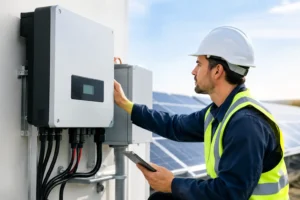
Solar is usually the main charging source for stationary off-grid use and summer touring. An MPPT charge controller converts panel voltage efficiently and must be configured with the correct LiFePO4 charging profile. Its output current must remain within the battery’s maximum charge rating.
As a broad example, 200W of solar can theoretically produce around 15A into a 12V battery under favourable conditions. Actual production varies with season, panel angle, shading, temperature and location. A 400W array offers faster recovery but needs correctly rated controller capacity, cable sizing and overcurrent protection.
Portable panels can be useful for motorhomes parked beneath trees or boats moored where fixed panel orientation is poor. Flexible, rigid, TOPCon, PERC and CIGS panels all serve different space and installation priorities. The battery does not determine the panel technology; available area, shade tolerance, weight and mounting method do.
Alternator charging
A lithium battery can accept charge rapidly, which is helpful during short driving stages but can overload a vehicle alternator if connected directly. A properly selected DC-DC charger manages current, provides the appropriate charging stages and protects both alternator and battery. This is especially relevant for Euro 5 and Euro 6 vehicles with smart alternators.
Mains charging
A lithium-compatible mains charger is the dependable backup for campsites, marina berths and home preparation. It should use a LiFePO4 profile and be sized to suit the battery’s permitted charge current. Faster charging is not always better if the battery bank is small or the installation has limited shore-power capacity.
Installation details that protect performance
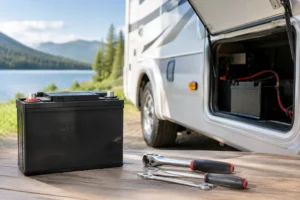
Lithium battery installations need the same discipline as any high-current DC system. Fit a correctly rated fuse close to the positive battery terminal, use cable cross-sections calculated for current and cable length, and secure the battery against movement. A battery monitor with a shunt is strongly recommended because lithium voltage remains relatively flat through much of its discharge cycle, making a basic voltage display an unreliable state-of-charge indicator.
Keep high-current inverter cables short and sized appropriately. Voltage drop on undersized cable wastes energy and can cause inverter low-voltage alarms even when the battery still has charge. Place the battery in a dry, accessible location away from direct engine heat, and follow the mounting orientation specified by its manufacturer.
If expanding capacity, use identical batteries of the same model, age and state of charge. Parallel connection increases amp-hour capacity while retaining 12V. Series connection increases system voltage but retains amp-hour capacity. Both arrangements require manufacturer approval, balanced cabling and charging equipment designed for the resulting battery bank.
When 100Ah is the right choice
A 12V 100Ah LiFePO4 battery is a strong choice for weekend motorhome trips, compact camper conversions, small boats, auxiliary power banks and modest off-grid solar systems. It is particularly effective where efficient refrigeration, lighting, pumps, communications and charging are the main loads.
It is less suitable as a single-battery answer for sustained electric heating, large inverters or several days of poor solar yield. In those cases, a larger 12V bank or a 24V system reduces current demand and provides more operating reserve. System design should follow the load profile, not a battery label alone.
The best installation is the one that leaves usable reserve after a cloudy day, accepts charge safely from every available source and has protection hardware sized for its highest realistic current. QuantEnergo technical support can help turn those figures into a battery, solar, controller and inverter system that is built for the way you actually travel or live off-grid.

No comment yet, add your voice below!