

A 100W panel may keep lights and USB charging alive on a summer weekend. It will not reliably support a compressor fridge, laptop work and an inverter in October. To understand how to size solar panels for a motorhome, start with the energy you actually use each day, then design for the least favourable conditions you expect to travel in.
Solar output is only one part of the electrical system. Panels must work with the battery bank, charge controller, cable protection and, where fitted, inverter. A correctly sized system gives useful autonomy without filling the roof with wattage that cannot be stored or regulated.
Start with daily energy consumption
List every appliance you expect to use away from hook-up and estimate its daily runtime. Use watts multiplied by hours to calculate watt-hours (Wh):
`Appliance power (W) × hours used per day = daily energy (Wh)`
A 45W compressor fridge running for an effective eight hours per day uses around 360Wh. A 60W laptop charged for three hours uses 180Wh. Add lighting, water pump, fans, television, router, diesel heater controls and mobile phone charging. For 12V appliances, the wattage is usually shown on the label; if only current is stated, multiply amps by voltage.
Do not forget inverter losses. A mains appliance drawing 100W from a 230V inverter may require 110-125W from the battery once conversion and idle consumption are included. High-wattage loads such as kettles, hair dryers, induction hobs and coffee machines are usually poor candidates for a modest 12V motorhome solar system. They demand substantial inverter capacity and rapidly drain even a large LiFePO4 battery.
For a practical planning figure, add 15-20% to your calculated consumption. This allowance covers controller losses, battery charging losses, cable losses, changing weather and the gap between a theoretical appliance duty cycle and real travel use.
A realistic motorhome example
Consider a couple touring with a 12V compressor fridge, LED lighting, water pump, mobile phones, a laptop and occasional television. Their daily consumption could look like this:
| Load | Daily energy use | | — | —: | | Compressor fridge | 400Wh | | LED lights | 50Wh | | Water pump and controls | 40Wh | | Mobile phones, tablets and router | 100Wh | | Laptop | 180Wh | | Television | 120Wh | | Total | 890Wh |
With a 20% system margin, this motorhome should plan to replace approximately 1,070Wh per day. That figure, not panel wattage alone, is the foundation of the design.
Convert daily demand into solar panel wattage
The basic calculation is:
`Required solar watts = daily Wh required ÷ peak sun hours ÷ system efficiency`
For motorhomes, an overall efficiency factor of 0.75 to 0.80 is sensible. It accounts for heat, non-ideal panel angle, dirt, cable losses and controller performance. Flat roof-mounted panels rarely achieve their nameplate output for long.
Peak sun hours vary sharply by location and season. In much of the UK, 3-4 peak sun hours can be a reasonable spring-to-summer planning figure, but winter production is far lower. Southern European touring conditions may provide 4-6 hours in favourable months. A motorhome parked under trees, beside a hedge or with its roof facing poorly towards the sun will produce less regardless of the forecast.
Using the 1,070Wh example and four peak sun hours:
`1,070Wh ÷ 4 ÷ 0.80 = 334W`
A 350W to 400W array is therefore a sound summer and shoulder-season target. If the same owners want to remain off-grid for long periods in northern Europe outside summer, 500W or more may be justified, but battery capacity and roof layout must support that decision.
Typical panel sizes by use case
A 100W-160W array suits light weekend use: lighting, water pump, mobile phones and modest battery maintenance. A 200W-300W array is more suitable for touring with a compressor fridge and normal DC loads. For remote work, extended off-grid stops, larger fridges or regular inverter use, 400W-600W is often the more dependable range.
These are design ranges, not guarantees. A 600W array cannot create winter sunshine, and a low-consumption motorhome does not need 600W merely because roof space is available.
Match solar production to battery capacity
Solar panels replace energy; batteries store it. If the battery bank is too small, a large solar array may reach absorption or float early and waste potential generation. If the battery bank is large but panels are undersized, recovery after a cloudy day or overnight use will be slow.
For a 12V LiFePO4 battery, usable energy can be estimated as:
`Battery Ah × 12.8V × usable depth of discharge = usable Wh`
A 100Ah LiFePO4 battery provides roughly 1,280Wh nominal energy. Allowing 90% usable capacity gives about 1,150Wh. That is close to one day of the example load, but it leaves little reserve for poor weather. A 200Ah LiFePO4 bank provides around 2,300Wh usable and gives a more practical two-day buffer.
LiFePO4 technology is particularly effective in motorhomes because it accepts charge efficiently, supports deeper routine discharge than lead-acid batteries and provides long cycle life when correctly installed. However, charging below 0°C requires appropriate battery protection or a controlled heating solution. Solar sizing cannot compensate for unsuitable low-temperature charging conditions.
As a general guide, a 300W-400W array pairs well with 100Ah-200Ah of 12V LiFePO4 storage, depending on daily demand and travel season. Larger arrays can charge smaller batteries safely when the charge controller is correctly configured, but there is little benefit in fitting far more panel power than the battery and controller can use during normal daylight.
Choose panel type around the roof, not just watts
Rigid framed panels normally offer the best long-term output per pound spent and maintain useful performance over many seasons. They need secure mechanical mounting and adequate airflow beneath the panel. Flexible panels are lighter and can suit curved or weight-sensitive roofs, but heat management, adhesive quality and service life need closer consideration.
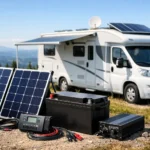
Portable folding panels are useful when the motorhome is parked in shade but a sunny pitch is nearby. They allow better orientation towards the sun, particularly in spring and autumn, although they require set-up, secure storage and protection against theft. A mixed arrangement can work well: permanent roof panels for daily charging, plus a portable panel for stationary off-grid stays.
Panel technology also matters where roof area is restricted. High-efficiency TOPCon or PERC panels can produce more power from a limited footprint than older designs. CIGS flexible panels can be valuable where low weight, partial shade tolerance or roof shape is the deciding factor. Check real dimensions, cable exit position and ventilation space before ordering. The advertised wattage is only useful if the panel physically fits around rooflights, vents, aerials and air-conditioning units.
Size the charge controller correctly
An MPPT controller is usually the right choice for motorhome solar arrays above small maintenance-panel size. It converts excess panel voltage into usable charging current more effectively than PWM regulation, especially in cool weather, lower light and arrays using higher-voltage panels.
For a 12V battery system, estimate controller output current by dividing solar wattage by battery charging voltage. A 400W array charging at approximately 14.4V can produce nearly 28A:
`400W ÷ 14.4V = 27.8A`
Choose a controller with headroom, so a 30A unit is the minimum and a 40A unit offers more operating margin. Always check both the controller’s maximum solar input voltage and its permitted PV wattage at 12V. Series-connected panels increase voltage; parallel-connected panels increase current. The correct configuration depends on panel specifications, cable runs, shading behaviour and the controller’s input limits.
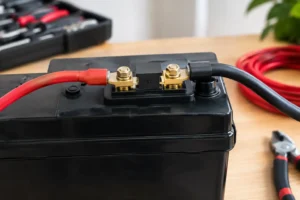
Use appropriately sized solar cable, fuses or circuit breakers, isolators and correctly rated connectors. Protection hardware is not an optional extra. It supports safe fault isolation and protects cables and equipment where high battery current is available.
Design for the season you actually travel
The most common sizing error is designing around a perfect July day, then expecting identical performance in a wet British autumn. If your motorhome is mainly used on summer holidays and moves frequently, 200W-300W with a sensible LiFePO4 battery bank may be enough. If you work remotely from the vehicle, spend several days in one location or travel across the UK and northern Europe in spring and autumn, design with more panel capacity and more stored energy.
Winter changes the calculation completely. Low sun angle, short days, cloud and shading can reduce production to a fraction of summer output. A solar array remains useful for maintenance and partial charging, but dependable winter autonomy may require driving to charge through a battery-to-battery charger, a mains charger, a generator, or a deliberate reduction in consumption.
Measure your loads for a week before buying hardware if possible. Then select panels, LiFePO4 storage and MPPT regulation as one system. QuantEnergo technical support can help verify voltage, controller capacity and physical fitment, but a clear daily Wh figure will always lead to a better motorhome solar design. Build for your real route and season, and your system will deliver power when the pitch has no hook-up to offer.



No comment yet, add your voice below!