

A battery that is left full on a marina berth, parked motorhome or seasonal off-grid cabin does not need the same treatment as one cycling daily through solar power. This LiFePO4 storage guide explains how to protect the battery, maintain usable capacity and keep the wider 12V or 24V system ready for reliable service.
LiFePO4 chemistry is well suited to mobile and independent power. It offers a long cycle life, stable voltage under load and considerably more usable capacity than a comparable lead-acid bank. Yet long service life still depends on correct charging, temperature management and sensible storage practice. A quality battery with an integrated BMS can protect against several fault conditions, but it cannot compensate for unsuitable charger settings, frozen cells or unnoticed standby loads.
LiFePO4 storage guide: start with state of charge
For long-term storage, aim to leave a LiFePO4 battery at roughly 40% to 60% state of charge. This middle range reduces cell stress compared with holding the battery at 100% for months, while leaving enough reserve for the BMS and any small unavoidable self-discharge.
A battery used every day in an RV or boat may regularly reach full charge. That is normal and often necessary when solar production is available and the next overnight load is uncertain. The concern is not reaching 100%, but remaining there continuously during long periods of inactivity.
Before storing the system, charge or discharge the battery to the preferred range, then isolate it from loads. Switch off the main battery isolator where fitted, or remove the negative connection only after confirming that this will not disrupt a critical safety or monitoring circuit. Parasitic loads such as alarms, routers, bilge pumps, trackers and inverter standby consumption can slowly drain a bank that seemed fully isolated.
Check state of charge every three to six months. The exact interval depends on the battery, BMS standby consumption, ambient temperature and whether any equipment remains connected. Recharge if the battery approaches the manufacturer’s low storage threshold. Do not leave it discharged for extended periods.
Do not rely on voltage alone
LiFePO4 voltage remains relatively flat through much of its discharge range. A simple voltmeter is useful for fault finding, but it cannot provide a precise state-of-charge reading when the battery is resting or under load. A shunt-based battery monitor is the better solution for systems where runtime planning matters, particularly on boats and off-grid sites.
A monitor records amp-hours entering and leaving the battery, helping you identify hidden demand and assess whether solar charging is keeping up. It also gives clearer evidence when choosing between a 100Ah and 200Ah battery, or when deciding whether a 12V installation should move to 24V.
Charge safely, especially in cold weather
The most critical storage rule is simple: do not charge a LiFePO4 battery below 0°C unless the battery specification explicitly permits it. Charging frozen cells can cause permanent damage. Many modern batteries include low-temperature charge protection through the BMS, but installers should treat that as a final safeguard, not a charging strategy.
For a motorhome stored outdoors over winter, disconnect or disable solar charging if the battery could fall below the permitted charge temperature. Alternatively, keep the battery in a protected compartment that remains within its operating range, or use a battery with suitable low-temperature protection and heating capability where specified.
Discharging at low temperatures is generally less restrictive than charging, although available capacity and power can fall. This matters for a boat on a cold mooring or an off-grid cabin used at weekends: the battery may power loads, but it must warm above the approved temperature before a solar controller, mains charger or alternator-to-battery charger begins charging.
Set every charging source correctly. A system may include an MPPT controller, shore-power charger, inverter-charger and DC-to-DC charger from the vehicle alternator. Each source must have a LiFePO4 charging profile or programmable voltage settings matching the battery manufacturer’s requirements. Leaving a lead-acid profile active can result in unsuitable absorption timing, float behaviour or equalisation settings.
Equalisation must be disabled. A LiFePO4 battery does not require it, and an equalisation programme designed for flooded lead-acid batteries may apply excessive voltage.
Build the storage system around real loads
Battery storage is only dependable when capacity, inverter power, cable protection and charging input are sized as one system. Start with energy consumption, not battery amp-hours. List the appliances you expect to run and multiply watts by hours of use. A 12V compressor fridge, lighting, water pump, laptop charging and diesel heater fan have different duty cycles, so use realistic daily figures rather than appliance ratings alone.
For example, 1,200Wh of daily consumption requires around 100Ah from a 12V battery in ideal conditions. In practice, allow margin for inverter losses, cold weather, poor solar yield and several days without meaningful charging. A 200Ah LiFePO4 battery gives substantially more reserve for extended touring or anchoring than a 100Ah unit, but it also needs adequate charging capacity and secure mounting space.
At higher power levels, 24V often becomes the more efficient choice. A 2,000W inverter can draw well over 170A from a 12V battery once losses are included. The same load at 24V requires roughly half the current, reducing cable size, voltage drop and stress on connections. For modest campervan loads, 12V remains practical and widely compatible. For larger inverters, longer cable runs and fixed off-grid installations, 24V deserves serious consideration.
Protect cables and connections
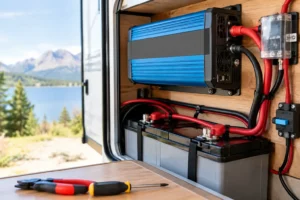
A high-quality battery cannot overcome undersized cable or poorly crimped lugs. Position the main fuse close to the battery positive terminal, select it to protect the cable while allowing expected inverter surge current, and fit a correctly rated battery isolator. Use suitably sized copper cable for the current and route length, with marine-grade terminals and corrosion protection where moisture or salt air is present.
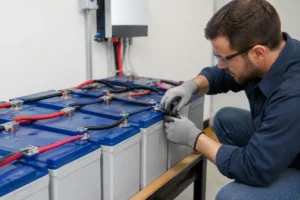
Check torque at battery terminals and distribution points periodically. Loose connections create resistance, heat and voltage drop, which can trigger inverter low-voltage alarms even when the battery has adequate charge. Keep terminals clean, dry and protected from tools or loose metal objects.
Solar, alternator and shore power must work together
Solar charging is usually the main recovery source for an independent system, but panel wattage should match seasonal use. A summer touring setup may recover daily consumption from a compact portable panel. A winter liveaboard boat or remote cabin may need more fixed panel area, a larger MPPT controller and a backup mains or generator charging option.
An MPPT controller is normally the preferred choice where panel voltage and available roof or deck space justify it. It can harvest more energy than PWM regulation in many conditions, particularly with higher-voltage panels and cooler weather. PWM can still be suitable for small, simple 12V systems where cost and panel matching are the priority.
Alternator charging also needs attention. A LiFePO4 battery can accept high current for long periods, which may overload an alternator not designed for continuous heavy output. A correctly specified DC-to-DC charger limits current, provides the proper LiFePO4 profile and prevents the leisure battery from draining the starter battery when the engine is off.
For shore power, use a charger with a suitable lithium programme and enough output to recharge the bank within your available connection time. A small charger may maintain a battery, but it may be too slow to recover a large 200Ah bank after several days off-grid.
Store the battery in a clean, dry, accessible location
Choose a secure location away from direct heat sources, standing water and exposed spray. LiFePO4 batteries do not vent acid gas during normal operation like flooded lead-acid batteries, but the installation still needs sound mechanical protection and sensible access for inspection. On a boat, consider vibration, heel, moisture and corrosion. In a motorhome, account for road vibration and make sure the battery cannot shift during braking.
Avoid sealing the battery into a space where you cannot reach the terminals, fuse or isolator. A practical installation makes routine checks quick: inspect cable condition, confirm charging status, test isolation and look for heat damage around high-current equipment.
If you are replacing lead-acid batteries, do not assume the existing wiring, charger and solar regulator are automatically suitable. The lower internal resistance and higher usable capacity of LiFePO4 can expose weaknesses that were less obvious with an older battery bank.
A correctly sized LiFePO4 system should feel uneventful: the fridge stays cold, navigation and communications remain available, and the inverter runs within its limits. If your travel pattern, solar area or load profile is unclear, confirm the complete battery, charging and protection specification before installation. QuantEnergo technical support can help turn those figures into a system designed for the way you actually travel, sail or live off-grid.

No comment yet, add your voice below!