

A battery locker beneath a motorhome seat can be only a few centimetres taller than the battery itself. A rear garage may have room for a larger bank but not for the weight placed behind the axle. That is why the best compact RV batteries are not simply the smallest models available. They are batteries that deliver useful usable energy, tolerate frequent cycling and fit safely within the real limits of the vehicle.
For most modern campervan and motorhome electrical systems, compact LiFePO4 batteries offer the strongest balance of size, weight and service life. The right choice still depends on the loads you intend to run, the charging sources available and the space around the installation. A 30Ah battery can be highly effective for lighting and a compressor fridge on short stays, while a compact 100Ah unit can support longer off-grid travel when paired with correctly sized solar and charging equipment.
What makes the best compact RV batteries?
A compact battery should be judged by more than its outside dimensions. Energy capacity, discharge capability, charging limits, battery management protection and mounting orientation all affect whether it will work reliably in an RV.
LiFePO4 chemistry is especially well suited to space-constrained installations. Compared with an equivalent lead-acid leisure battery, it provides substantially more usable capacity because it can normally be discharged more deeply without the same damage risk. It also maintains voltage more consistently under load, weighs less and can deliver a long cycle life – quality LiFePO4 designs can exceed 6,000 cycles under suitable operating conditions.
That does not mean every lithium battery is interchangeable. Check the continuous discharge current before connecting an inverter, the maximum charge current before selecting a charger, and whether the internal BMS includes low-temperature charging protection. In cold conditions, a LiFePO4 battery should not be charged below its specified temperature limit unless it has an appropriate heating system or charge inhibition.
Physical fit remains non-negotiable. Measure the available length, width and height, then allow clearance for cable bends, terminals, fuses and ventilation around associated equipment. A battery that fits on paper but prevents the seat base from closing is not a compact solution.
Choose compact RV battery capacity by how you travel
Capacity is expressed in amp-hours, but watt-hours give a clearer picture of available energy. A 12.8V 30Ah LiFePO4 battery stores roughly 384Wh, while a 12.8V 100Ah battery stores around 1,280Wh. Actual usable energy depends on the battery’s BMS limits, cable losses and the loads being powered.
30Ah to 50Ah: efficient weekend systems
A compact 30Ah or 50Ah LiFePO4 battery suits small camper conversions, pop-top vans, teardrop trailers and users who mainly require 12V power. This range can run LED lighting, USB charging, a water pump, a diesel heater control system and a compressor fridge for limited periods, especially when daily solar input is available.
The trade-off is reserve capacity. A 12V compressor fridge may use 25Ah to 50Ah over a day depending on ambient temperature, insulation and how often the door is opened. Add laptop charging, a fan or a TV, and a 30Ah battery can be depleted quickly. Compact capacity works best where electrical habits are disciplined and recharging is frequent.
100Ah: the compact all-rounder
For many motorhome owners, a slim or space-efficient 100Ah LiFePO4 battery is the practical starting point for genuine off-grid autonomy. It provides enough reserve for a compressor fridge, lights, pumps, device charging and moderate evening use without demanding the footprint of a large multi-battery bank.
A 100Ah battery does not automatically make high-power appliances suitable. A 1,000W inverter can draw more than 80A from a 12V battery, and the real current rises once inverter losses are included. Check that the battery BMS, isolator, fuse, cable cross-section and terminals are rated for the expected load. For a kettle, induction hob or electric heating, increasing battery capacity alone is rarely the right answer.
When two smaller batteries are better
In some RVs, two compact batteries are easier to install than one large case. They can be positioned closer to the centre of the vehicle, split between accessible compartments or arranged to preserve storage space. Parallel 12V batteries must be identical in chemistry, capacity, age and state of charge, with correctly balanced cable connections.
This approach adds flexibility but also adds connections, protection requirements and potential installation errors. One larger battery is often simpler. Two smaller units make sense when the vehicle layout makes a single battery physically impractical.
12V or 24V for a compact installation?
A 12V battery system is usually the most straightforward option for campervans and conventional motorhomes. Most fridges, pumps, lighting, diesel heaters and vehicle-focused accessories are designed for 12V DC. A 12V LiFePO4 battery integrates easily with a 12V fuse board, DC-DC charger and solar charge controller.
A 24V system becomes more attractive as inverter loads increase. At the same power, 24V halves the current compared with 12V. Lower current can allow smaller cable sizes, reduce voltage drop and make a high-output inverter installation more manageable. It is particularly relevant for larger motorhomes, expedition vehicles and combined RV or off-grid systems.
The compromise is compatibility. You may need a 24V inverter, 24V solar charging arrangement and DC-DC converters for 12V appliances. Select voltage according to the whole electrical architecture, not simply the battery size.
Build charging around the battery, not the other way round
A compact battery can only provide dependable autonomy if it is recharged correctly. Most travelling RVs benefit from three charging paths: solar when parked, alternator charging while driving and mains charging on a campsite or at home.
Solar is particularly valuable for compact batteries because it restores daily energy without running the engine or seeking hook-up. Match panel wattage and controller capacity to the battery bank and available roof area. An MPPT controller generally makes better use of higher-voltage panel configurations and variable sunlight than a basic PWM controller, particularly where roof space is limited and every watt matters.
A DC-DC charger protects both the vehicle charging system and the leisure battery by providing a controlled charge profile. This is increasingly important in vehicles with smart alternators, where voltage can vary significantly. Do not rely on an old split-charge relay to deliver the correct lithium charging conditions unless the vehicle and battery specifications explicitly support it.
Mains charging should also be lithium-compatible. Set the correct absorption and float parameters where the charger allows configuration, and do not exceed the battery’s maximum recommended charge current. Faster charging is useful, but it is not a reason to overload a compact battery or its cabling.
Installation details that protect performance
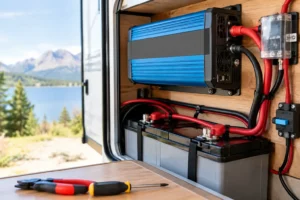
A small battery compartment can encourage shortcuts. Avoid them. Install a correctly rated fuse close to the battery positive terminal, use a battery isolator, secure the battery against movement and protect cables where they pass through metalwork. Select cable size according to current, cable length and permitted voltage drop, not appearance.
LiFePO4 batteries do not require the same venting as flooded lead-acid batteries, but the compartment still needs to stay dry, accessible and away from direct heat sources. Do not mount a battery where it may be exposed to spray, condensation or heat from an engine bay unless the product is explicitly rated for that environment.
It is also wise to leave access for inspection and service. You should be able to reach the main fuse, isolate the battery and inspect terminal tightness without dismantling half the vehicle interior. A battery monitor with a shunt gives a more reliable state-of-charge reading than voltage alone, particularly with LiFePO4 chemistry, which holds a relatively flat voltage curve through much of its discharge cycle.
Avoid these compact battery selection mistakes
The first mistake is choosing by amp-hours alone. A cheap battery with an undersized BMS may not support the inverter current you need. The second is overlooking dimensions at the terminals and cable exits. The third is fitting a high-capacity battery without enough solar, alternator or mains charging to replenish it.
Another common error is retaining lead-acid charging settings after upgrading to lithium. Verify every charging source, including solar controller, DC-DC charger and mains charger. Finally, do not underestimate load growth. A system that starts with lights and a fridge often gains a laptop, router, TV, coffee machine or e-bike charger over time.
For a compact, long-life RV power system, choose the battery after mapping your daily energy use, your usable installation space and your charging opportunities. QuantEnergo can help match LiFePO4 storage with solar panels, charge control, inverter capacity and protection hardware, so the battery becomes a dependable part of the complete system rather than the next limitation on your travels.


No comment yet, add your voice below!