

A battery upgrade changes far more than the time between hook-ups. The right RV battery upgrade options can support overnight heating controls, compressor refrigeration, remote work, induction cooking and inverter loads without the familiar voltage drop that makes lead-acid systems feel depleted long before they are empty. The wrong upgrade can leave a high-performance battery undercharged, poorly protected or unable to accept power from the alternator.
For most motorhome owners, the decision is no longer simply wet leisure battery versus AGM. It is about matching battery chemistry, usable capacity, charging equipment and cable protection to the way the vehicle is actually used. A weekend touring van with a 12V fridge has different requirements from an off-grid motorhome running a 230V coffee machine and solar array.
RV battery upgrade options: choose chemistry first
Flooded lead-acid batteries remain the lowest-cost option at purchase. They can suit modest seasonal use where mains charging is readily available and the battery compartment is ventilated. Their limitation is usable capacity. Regularly discharging a nominal 100Ah lead-acid battery much below 50% shortens its service life, so only around 50Ah is sensible for routine use.
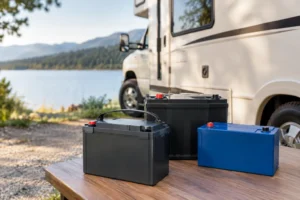
AGM batteries are sealed, more resistant to vibration and generally better able to supply higher current than standard flooded batteries. They are a practical replacement where an existing charger has an AGM setting and the electrical demand remains moderate. However, AGM batteries are still heavy, charge relatively slowly near full capacity and lose effective capacity when discharged hard or used in cold conditions.
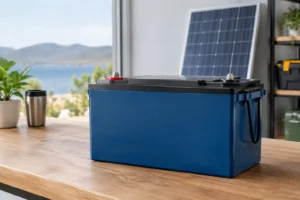
LiFePO4 lithium batteries are the strongest long-term option for most self-sufficient RV electrical systems. A 12V 100Ah LiFePO4 battery typically provides around 80-100Ah of practical usable capacity, holds voltage more consistently under load and can accept charge much faster than lead-acid. It also weighs substantially less, a useful gain when payload matters. Batteries designed for 6,000+ cycles can offer a much lower cost per cycle than repeatedly replacing lead-acid units.
Lithium is not automatically a drop-in solution. The battery must include a correctly rated battery management system, known as a BMS, and the charging system must use lithium-appropriate voltage settings. A battery without low-temperature charge protection should not be charged below 0°C. For winter touring, that detail matters as much as amp-hour capacity.
Size capacity around real daily consumption
Battery capacity is often selected by looking at the old battery tray rather than the energy requirement. That is how owners end up with a new battery that fits physically but delivers no meaningful improvement in autonomy.
Start with daily watt-hours. Multiply each appliance’s power draw by the hours it runs each day. A 45W compressor fridge averaging 10 hours of compressor operation uses about 450Wh. Add lights, water pump, diesel heater fan, device charging, TV, router and any inverter-fed appliances. An inverter also has its own standby consumption, which can be significant over a full day.
For a 12V battery bank, divide watt-hours by 12 to obtain a useful approximate amp-hour figure. A daily demand of 900Wh is roughly 75Ah at 12V before allowing for inverter losses, wiring losses and reserve capacity. A 100Ah LiFePO4 battery may cover this for one day, but a 200Ah battery gives more practical margin for poor weather and avoids deep daily cycling.
As a working guide, a compact camper using lights, a pump, phones and a compressor fridge may be well served by 100Ah LiFePO4. A motorhome with extended off-grid stays, a larger fridge, heating fan and regular inverter use will commonly benefit from 150Ah or 200Ah. High-demand installations may need a larger 12V bank or a move to 24V.
Do not size only for an average sunny day. Plan for at least one day with limited solar harvest, particularly when travelling outside peak summer. Battery reserve is what turns an electrical system from adequate into dependable.
12V or 24V: match the system voltage to the load
A 12V battery system is straightforward for most campervans and motorhomes because existing lights, pumps, fans and compressors are normally 12V. It also keeps replacement parts widely available. A 12V 100Ah or 200Ah LiFePO4 battery is a compact foundation for many installations.
A 24V system becomes attractive when inverter power and battery capacity rise. The same 2,000W inverter load draws roughly 167A from a 12V system before losses, but around 83A from a 24V system. Lower current means smaller voltage drop, more manageable cable sizes and reduced stress on connections. This is particularly valuable for larger motorhomes, expedition vehicles and systems using 2,000W to 3,000W inverters.
The trade-off is compatibility. A 24V battery bank requires a suitable 24V solar controller, charger and inverter, while 12V vehicle loads need a correctly rated 24V-to-12V DC-DC converter. Avoid building a 24V bank by permanently pairing unrelated 12V batteries unless the manufacturer explicitly approves series connection and the installation is designed around balancing and protection. A purpose-built 24V LiFePO4 battery is usually the cleaner engineering choice.
Upgrade the charging path, not just the battery
A lithium battery can accept charge rapidly, but only if the charging sources are configured to provide it safely. This is where many otherwise good upgrades fall short.
Alternator charging
Modern vehicles commonly use smart alternators that vary their output voltage. Directly connecting a large lithium battery bank may result in poor charging, high alternator load or unreliable operation. A DC-DC battery-to-battery charger solves this by providing a controlled lithium charging profile and limiting the current drawn from the starter-battery circuit.
Choose the charger output around both the battery and the alternator. A 30A unit suits many campervan conversions; 40A or 50A may be appropriate for larger banks and longer driving days, provided cable size, fuse ratings and alternator capacity support it. The starter battery connection, output connection and earth return all need appropriate fusing and sound terminations.
Solar charging
Solar is often the most effective companion to a LiFePO4 upgrade because lithium can absorb high charge current during changing sunlight. An MPPT controller is normally preferable to PWM where panel voltage is higher than battery voltage, roof area is limited or output in mixed weather matters. It harvests more usable energy from flexible, rigid, portable, TOPCon, PERC or CIGS panel configurations when correctly matched.
Controller current rating is not a cosmetic specification. A 400W solar array charging a 12V battery can exceed 30A in favourable conditions, so allow suitable headroom. Set the controller to the battery manufacturer’s absorption, float and low-temperature charging requirements rather than copying lead-acid defaults.
Mains charging and inverter-chargers
Check the existing 230V charger before fitting lithium. Some older chargers have fixed lead-acid profiles that float at unsuitable voltages or never bring lithium to a proper full charge. A programmable lithium charger or hybrid inverter-charger provides a controlled shore-power charging source and can simplify an inverter-based system.
For inverter use, calculate the continuous load and the startup surge. A 1,000W inverter may be sufficient for laptops and light kitchen equipment, while kettles, hair dryers and induction hobs often demand 2,000W or more. At 12V, these loads require very high battery current. Use short, correctly sized cables, a main fuse close to the battery positive terminal and a battery BMS with adequate continuous and peak current capability.
Physical fit, protection and installation details
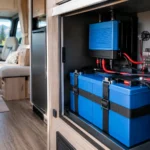
A battery is only as reliable as its installation. Measure the available compartment carefully, including terminal clearance, cable bend radius and access for isolation. A lighter lithium battery should still be securely restrained against braking loads and rough-road vibration.
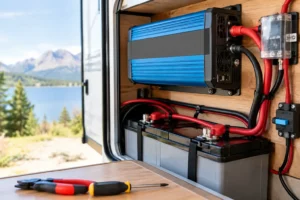
The essential protection hardware is not optional. Fit a battery isolation switch, correctly sized fuses or circuit breakers, and cable sized for the actual current and route length. Undersized cable wastes energy as heat and can cause inverter low-voltage shutdown even when the battery is healthy. Fit the primary fuse as close to the positive battery terminal as practical.
A battery monitor with a shunt is equally valuable. Voltage alone is an unreliable state-of-charge indicator for LiFePO4 because it remains comparatively stable through much of the discharge cycle. A shunt-based monitor records current in and out, making it easier to identify overnight consumption, solar contribution and unexpected loads.
If expanding an existing lithium bank, use batteries of the same chemistry, voltage, capacity and age where possible. Mixing an old battery with a new one can cause uneven loading and complicate BMS behaviour. Parallel installations should use equal-length, correctly sized interconnects and take positive and negative system feeds from opposite ends of the bank to improve current sharing.
Choose for the trips you actually make
The best battery upgrade is not necessarily the largest one that fits. A 100Ah LiFePO4 battery with 200W of well-regulated solar and a 30A DC-DC charger can outperform a poorly charged 200Ah battery bank. Conversely, a high-capacity bank is justified when winter travel, long stationary stays, medical equipment, remote work or high inverter loads make energy reserve non-negotiable.
Quantum Battery systems are designed around this whole-installation approach: long-life 12V and 24V LiFePO4 storage paired with solar, charging, inverter and protection equipment that work as one electrical system. Before ordering, confirm your daily load, available charging sources, physical space and maximum current requirement. Those four figures will point to a battery upgrade that keeps the lights on when the pitch has no hook-up and the next stop is still a long way down the road.



No comment yet, add your voice below!