

A 2,000W inverter can draw well over 160A from a 12V battery bank, yet around 80A from a 24V bank delivering the same AC load. That single difference affects cable size, fuse selection, voltage drop, charging equipment and the practical limits of your installation. Choosing between 12V versus 24V systems is therefore not simply a battery-voltage decision. It defines how the complete motorhome, marine or off-grid power system should be built.
For compact leisure installations, 12V remains highly practical because most onboard equipment already runs at 12V. For larger inverter loads, longer cable runs and higher solar capacity, 24V can make the system more efficient, cleaner to install and easier to expand. The right answer depends on the loads you intend to run, not on which voltage appears more advanced.
12V versus 24V systems: the electrical difference
Voltage is the electrical pressure that moves current through a circuit. Power is measured in watts, and the basic relationship is simple: watts equal volts multiplied by amps. If a load needs 1,200W, a 12V system must supply roughly 100A before allowing for inverter losses. A 24V system supplies roughly 50A.
Lower current matters because current creates heat and voltage drop in cables, terminals, fuses and switches. High-current 12V installations need short, carefully protected cables with a larger conductor cross-section. This is entirely manageable when correctly designed, but it becomes more costly and physically demanding as inverter power rises.
A 24V system does not create extra energy from the same battery capacity. Two 12V 100Ah LiFePO4 batteries connected in series provide a 24V 100Ah bank, equivalent to 2,400Wh nominal energy. Two identical batteries in parallel provide a 12V 200Ah bank, also equivalent to 2,400Wh. The stored energy is the same. What changes is the current required to use and recharge it.
When a 12V system is the better choice
A 12V LiFePO4 battery bank is usually the logical solution for campervans, smaller motorhomes, day boats, fishing boats and straightforward auxiliary-power upgrades. Fridges, water pumps, diesel heaters, LED lighting, roof vents, USB chargers and much marine electronics are commonly available in 12V versions. They can be supplied directly from the battery through an appropriate fused distribution panel, with no inverter losses.
A 12V configuration also suits installations with modest AC demand. If the inverter is mainly used for laptop charging, camera batteries, a small television or occasional low-power appliances, a quality pure sine wave inverter in the 600W to 1,200W range is often a sensible fit. Cable runs between battery and inverter should still be as short as possible, and cable sizing must be based on the inverter’s maximum DC current rather than its typical daily use.
Solar expansion is straightforward at 12V, particularly for one or two panels and a correctly matched MPPT controller. However, do not assume a panel labelled as a ‘12V solar panel’ should connect directly to a 12V battery. Its operating voltage is normally higher than battery voltage, and the controller is the component that converts the panel output into safe battery charging.
Twelve volts also offers broad equipment availability. Replacement accessories, battery monitors, DC-DC chargers, bilge pumps and vehicle-rated appliances are easy to source. This can make fault-finding and future modifications simpler when travelling.
The practical limit of 12V
The limitation appears when high AC loads become routine. A 2,000W inverter may draw 180A or more at low battery voltage once inverter losses are included. A 3,000W inverter can exceed 250A. At these currents, every connection must be exceptionally well made, and the required copper cable can be large, stiff and expensive.
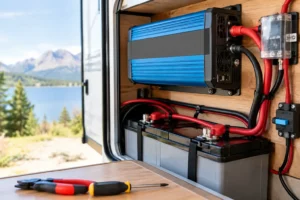
This does not mean a 12V 2,000W system is automatically wrong. It can work well in a compact motorhome where the inverter sits close to a high-capacity battery bank. But it demands disciplined installation practice: correctly rated Class T or MEGA fuses where appropriate, suitable battery isolation, properly crimped lugs, protected cable routing and a battery with sufficient continuous discharge capability.
When 24V makes more sense
A 24V battery system is usually the stronger engineering choice for larger motorhomes, liveaboard boats, cabins, workshops and fixed off-grid installations with meaningful inverter demand. Halving the current for the same power reduces voltage drop and allows smaller cable sizes for comparable cable lengths. This is especially valuable where battery-to-inverter cables cannot be kept short.
Consider a boat with a 3,000W inverter for galley appliances, power tools or a watermaker. At 24V, DC current remains demanding but far more manageable than at 12V. The same applies to an off-grid cabin running a pressure pump, refrigeration, communications equipment and occasional household appliances.
Higher solar capacity is another reason to select 24V. Larger arrays can be handled with lower battery-side current, provided the MPPT controller is rated for the array voltage, output current and battery voltage. The controller specification must be checked carefully. A controller may accept a high solar open-circuit voltage but have a lower maximum charging current, which ultimately limits usable panel capacity.
Twenty-four volts is also a sound platform for growth. If the initial installation is modest but the plan includes a larger inverter, more solar or longer operating periods away from shore power, starting at 24V can avoid replacing major cabling and protection equipment later.
The trade-off: supplying 12V loads
Most motorhomes and many marine DC appliances are still 12V. A 24V system therefore requires a correctly sized 24V-to-12V DC-DC converter for those circuits. This is not a problem when designed properly, but it adds a component and creates a separate current calculation.
For example, a 12V fridge drawing 8A, lighting, pumps and charging sockets may collectively require a 30A or 40A converter, with headroom for start-up loads and future additions. The converter must be installed with appropriate fuses on both its 24V input and 12V output. Do not run 12V appliances directly from one battery in a 24V series bank. This creates unequal battery discharge and charging, shortening bank life and causing imbalance.
Battery configuration and charging compatibility
A dedicated 24V LiFePO4 battery is often the neatest choice for a new 24V system. It uses an internal battery management system designed for that voltage and avoids the need to manage separate batteries in series. Two matched 12V lithium batteries can also be connected in series only when the manufacturer explicitly permits series operation and both batteries are the same model, age and state of charge.
For 12V systems requiring more storage, parallel batteries must likewise be matched and wired so that charge and discharge currents are shared evenly. Use equal-length, equal-size cables to a common positive and negative busbar rather than taking every load from the terminals of one battery.
Every charging source must match the bank voltage. This includes solar MPPT controllers, mains battery chargers, alternator chargers and wind turbine controllers. A 12V alternator cannot correctly charge a 24V house bank without a purpose-designed DC-DC charging solution. Similarly, a 24V charger must never be connected to a 12V battery bank.
Lithium charging profiles are as important as nominal voltage. Select equipment with a LiFePO4 setting or programmable absorption, float and low-temperature protections. A battery monitor with a shunt provides a far more reliable state-of-charge reading than voltage alone, particularly with LiFePO4 chemistry, where voltage remains relatively flat through much of the discharge cycle.
Size the system from loads, not battery labels
Start with an energy audit. List each appliance, its wattage or current draw, and realistic daily operating hours. Convert the total to watt-hours. A 60W compressor fridge running for eight hours of equivalent compressor time consumes around 480Wh per day; a 1,500W kettle used for five minutes consumes about 125Wh. High-wattage appliances can have short runtimes, but they still impose substantial instantaneous inverter and battery-current demands.
Then consider autonomy, solar harvest, alternator charging and seasonal conditions. A system that works during a bright July touring holiday may need considerably more battery capacity and panel area for autumn or winter off-grid use. Battery capacity should also retain a practical reserve rather than being planned around complete daily discharge.
For many vehicle builds, 12V with 100Ah to 200Ah of LiFePO4 storage is an efficient and familiar solution. For higher-demand electrical independence, 24V storage paired with an appropriately sized inverter, MPPT controller and DC-DC converter is often the more scalable route. The decisive factor is not amp-hours alone. Compare usable watt-hours, continuous current capability and the equipment required around the battery.
Choose the voltage that simplifies your real installation
Choose 12V where direct compatibility with vehicle or marine loads, compact scale and simple servicing matter most. Choose 24V where inverter power, solar capacity, cable distance or future expansion makes 12V current impractical. Both can deliver long-life, dependable energy storage when the battery, controller, inverter, cabling and protection hardware are specified as one system.
Before purchasing hardware, draw the battery bank, charging sources, major loads, fuses, isolators and cable lengths on one diagram. That small design step exposes mismatched voltages and undersized components early, and gives you a system that supports independent travel rather than limiting it.




No comment yet, add your voice below!