

A 200Ah battery looks like a straightforward capacity upgrade until it has to start a 2,000W inverter, accept solar charge on a grey winter morning, and fit into a tight motorhome locker. This 200Ah LiFePO4 review focuses on the questions that determine whether this size is a genuine step towards electrical independence or simply more battery than your system can use.
For many RV, marine and off-grid owners, 200Ah is the practical high-capacity point in a 12V system. It can support several days of sensible DC consumption, run substantial AC loads through an inverter, and remain far lighter and more usable than an equivalent lead-acid bank. The result, however, depends on usable energy, BMS limits, charging equipment and installation design – not the amp-hour figure alone.
200Ah LiFePO4 review: the usable energy advantage
A nominal 12.8V, 200Ah LiFePO4 battery stores approximately 2,560Wh, or 2.56kWh. Unlike lead-acid batteries, lithium iron phosphate batteries can normally provide most of that capacity without the routine deep-discharge damage associated with traditional leisure batteries. Planning around 2.1 to 2.3kWh of usable energy is a sensible, conservative starting point, allowing for inverter losses, wiring losses, temperature and a margin before low-voltage protection intervenes.
That is the first major reason to consider 200Ah. A pair of 100Ah lead-acid leisure batteries may appear comparable on paper, but if only around half their rated capacity is regularly usable, the real energy available can be much lower. Lead-acid voltage also sags under heavier loads. A LiFePO4 battery holds a more stable voltage through most of its discharge cycle, which helps compressors, pumps and inverters operate more predictably.
The cycle-life case is equally strong for applications used frequently. Quality LiFePO4 cells can be specified for 6,000+ cycles under defined operating conditions. A battery used through regular touring, liveaboard boating or daily solar storage therefore has the potential to deliver value over many years. This is not a promise that every installation will achieve the same service life: high temperatures, charging outside specification and sustained heavy loading all affect longevity. It is, however, a different ownership model from replacing depleted lead-acid batteries every few seasons.
What can a 200Ah battery actually run?
Runtime is best calculated from watt-hours, not optimistic appliance labels. Divide usable battery energy by the real average wattage of the load, then account for inverter efficiency where AC equipment is involved.
With roughly 2.2kWh available, a 60W compressor fridge averaging 30W over a day may consume around 720Wh in 24 hours, depending on ambient temperature and ventilation. That leaves meaningful capacity for LED lighting, water pumps, device charging, a router and occasional TV use. In a well-designed motorhome, this can cover a night or two away from hookup before solar contribution.
High-wattage heating appliances change the picture quickly. A 1,200W kettle used for four minutes consumes only about 80Wh, which is manageable. A 1,500W electric heater running for one hour needs around 1.5kWh before inverter losses. Battery capacity is not a substitute for gas heating, diesel heating or a properly sized generator where sustained heat is required.
For a boat, 200Ah can suit navigation electronics, lighting, pumps, refrigeration and charging equipment, while providing a useful reserve for anchor nights. For a fixed off-grid cabin, it is often a modular building block rather than the whole storage bank. Daily loads, winter solar yield and backup charging availability should decide the final capacity.
The BMS rating matters as much as capacity
The battery management system, or BMS, protects the cells from overcharge, over-discharge, excess current and unsafe temperature conditions. Its continuous discharge rating sets the practical inverter size more reliably than the 200Ah capacity figure.
A 100A BMS at 12V supports approximately 1,280W in theory, but continuous real-world use should allow headroom. A 150A or 200A BMS is better suited to a larger inverter, particularly where induction cooking, coffee machines or power tools are expected. Inverter surge ratings also matter. Compressors and some workshop tools can draw a brief starting current well above their running consumption.
Check the continuous discharge current, peak or surge current, maximum charge current and low-temperature charge protection in the battery specification. Do not assume that two batteries described as 200Ah have the same high-load capability. The cells may have similar energy storage, while their BMS, terminals and internal cabling create very different operating limits.
Charging: solar, alternator and mains must be matched
A 200Ah LiFePO4 battery can accept charge much faster than lead-acid, provided the charge source and battery limits permit it. This is useful after a night at anchor or a weekend off-grid, but it also exposes weak cables, undersized fuses and unsuitable chargers.
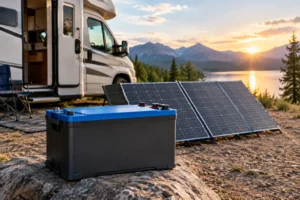
Solar is usually the most efficient partner. A 400W array may produce roughly 1.5 to 2.0kWh on a favourable summer day, depending on panel angle, shading and location. That can make a substantial contribution to a 200Ah battery. In winter, particularly in northern Europe, output can fall dramatically. Extra battery capacity only postpones the need for charging; it does not create energy.
Use an MPPT controller sized for the panel array and configured for LiFePO4 charging voltages. Portable panels can be valuable for parked motorhomes and boats at anchor, while fixed roof panels suit regular touring. The correct choice depends on available surface area and whether avoiding shade is more important than permanent convenience.
Alternator charging needs equally careful planning. A LiFePO4 battery can draw high current for an extended period, potentially overheating an alternator that was designed only to replenish a starter battery. A DC-to-DC charger regulates the charge profile and current, protecting the alternator and providing correct lithium charging. For shore power, fit a mains charger with a LiFePO4 programme rather than relying on an old lead-acid-only unit.
Installation considerations in RV and marine systems
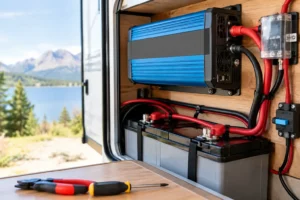
A 200Ah LiFePO4 battery is compact for its energy, but it is not small. Confirm dimensions, terminal orientation, cable bend space and service access before ordering. The mounting location should be dry, mechanically secure and away from direct engine-bay heat. On a boat, protect terminals from accidental contact and corrosion, and ensure the installation meets the vessel’s electrical safety requirements.
Cable sizing and fusing are safety-critical. A 12V inverter drawing 150A does not tolerate undersized cable or loose crimp terminals. Fit appropriately rated fuses close to the battery positive terminal, use a battery isolator where appropriate, and keep high-current cable runs short. Voltage drop that seems minor at 230V becomes significant in a 12V system.
Temperature deserves attention. LiFePO4 batteries should generally not be charged below 0°C unless the battery has controlled self-heating or the manufacturer specifically permits it. Discharge may remain possible at lower temperatures, but available capacity and performance can reduce. For winter motorhome storage, an insulated internal locker is often a better choice than an exposed external compartment.
Is 12V 200Ah the right format?
A 12V 200Ah battery suits many campervans, motorhomes, small boats and modest off-grid systems because common appliances, chargers and solar equipment are readily available. It is an especially logical upgrade when replacing a 12V lead-acid leisure bank without redesigning the entire electrical system.
There is a threshold where 24V becomes more efficient. If your inverter is 2,000W or larger, a 12V system requires very high current. At 24V, the same power uses roughly half the current, allowing smaller cables and lower voltage drop. Larger off-grid cabins, serious workshop loads and high-output inverter systems should therefore be assessed as 24V systems from the start.
Parallel 12V batteries can increase capacity, but only where the battery manufacturer permits it and the batteries are matched by model, age and state of charge. Properly balanced cable connections are necessary so each battery shares charging and load current evenly. In many cases, one correctly sized high-capacity battery is simpler than a bank assembled from mismatched units.
Long-term value versus the upfront price
LiFePO4 remains more expensive at purchase than a basic lead-acid battery, so the comparison must include usable energy, recharge efficiency, cycle life, weight and replacement frequency. For a vehicle used only a few summer weekends each year, the financial case may be less urgent. For regular travellers, liveaboard users and off-grid households cycling storage daily, the operational advantages become much more compelling.
The best purchase is not necessarily the lowest-priced 200Ah unit. Look for clear specifications, suitable BMS current capability, low-temperature protection, declared parallel or series compatibility, warranty terms and technical support from a supplier that understands complete systems. QuantEnergo can assist with matching battery storage to solar, charging, inverter and protection hardware rather than treating capacity as an isolated purchase.
A 200Ah LiFePO4 battery earns its place when it is supported by a charging plan and protected by correct installation hardware. Start with your daily watt-hour demand, identify the largest simultaneous AC load, then size the battery, inverter, solar array and cables as one system. That approach produces quieter nights, fewer hookup compromises and power you can rely on when the next pitch, anchorage or off-grid site is well away from the mains.

No comment yet, add your voice below!